(Spoken Word Video linking to today's Video Vixens)
Saartjie Baartman Tragic Venus circa 1789 - 1 January 1816
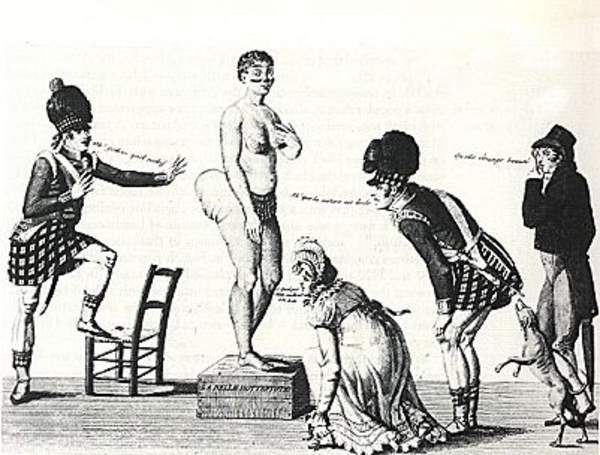
Saartjie Baartman was born in 1789 into the Griqua tribe of the eastern Cape, a subgroup of the Khoisan people who are now thought to be the first aboriginal inhabitants of the southern tip of Africa. Her family moved to a shack near Cape Town and, while working as a 20-year-old servant to a local farmer, she attracted the attention of a visiting English ship's surgeon, William Dunlop. What made her a curiosity in the doctor's eyes were her extraordinary steatopygia — enlarged buttocks — and her unusually elongated labia, a genital peculiarity of some Khoisan women of the time.
She agreed to go with Dunlop to England where, he promised her, she would become rich and famous as a subject of medical and anthropological research. She was 21 when she left Cape Town for London. At first, she was indeed put under anatomical scrutiny by scientists, who named her genital condition the 'Hottentot apron'. 'Hottentot' was a word coined by early Dutch settlers to South Africa to describe the strange clicking language of the Khoisan. But the only success she achieved was as an exhibit before the general public.
Contemporary descriptions of her shows at 225 Piccadilly, Bartholomew Fair and Haymarket in London say Baartman was made to parade naked along a "stage two feet high, along which she was led by her keeper and exhibited like a wild beast, being obliged to walk, stand or sit as he ordered". People paid one shilling to gawk at her, where she was depicted as a wild animal in a cage, dancing for her keeper. For several years, working-class Londoners crowded in to shout vulgarities at the protruding buttocks and large vulva of the unfortunate woman.
~~--and today in 2008, we let it all HANG out) This is what Minister Farrakhan tries to teach, about the sacredness of our bodies. ~~~~~~~~~~~~~~~~~~~~~~~~~~~~~~~~~~~~~~~~~~~~~~~~~~~~~~```
The aristocracy were no less fascinated at what they saw as a s*xual freak, but they had private showings. Baartman was supposed to earn half of the proceeds from her performances, but in fact she saw little of the profits. In 1814, after spending four years being paraded around the streets of London, Baartman was taken to Paris and, according to the archival accounts, was handed to a "showman of wild animals" in a travelling circus. Her body was analysed by scientists, including Baron Cuvier, one of Napoleon Bonaparte's surgeons. ~~SO BROTHERS? DON'T PIMP YOUR SISTERS" in any way shape or form.
A number of pseudo-scientific articles were written about her, testimony at the time to the superiority of the European races.
Her anatomy even inspired a comic opera in France. Called "The Hottentot Venus" or "Hatred to French Women", the drama encapsulated the complex of racial prejudice and s*xual fascination that occupied European perceptions of aboriginal people at the time. It appears Baartman worked as a prostitute in Paris and drank heavily to cope with the humiliation she was subjected to. Sad and homesick, she died a lonely alcoholic on January 1 1816, probably of pneumonia.
But even then she was to suffer indignity. Less than 24 hours after her death she was carved up by Baron Cuvier. He had her body cast in wax, dissected and her skeleton articulated. Her genitalia and brain were pickled and displayed at the Musee de l'Homme (Museum of Mankind). They were finally withdrawn from public view in 1974, and her remains were assigned to a storeroom and forgotten. ~~~~~~~~~~NELSON MANDELA KNOWS HIS HISTORY.~~~~~~~~~~~~ But some Africans never forgot Baartman. Nelson Mandela made a request to France in 1994 for her remains to be handed back. Her cause gained momentum amid post-apartheid South Africa's new awareness of tribal identity. All over the country, aboriginal peoples are asserting their heritage rights, claiming not only political and cultural recognition, but also the restitution of ancestral land and the protection of intellectual property rights. The San, once known as the bushmen of southern Africa, have successfully reclaimed historic tribal land and won a share in the proceeds of internationally marketed drugs made from their traditional medicinal plants.
And now Baartman's Khoisan tribe, which has been recognized by the United Nations as an indigenous "First Nation," has won a victory for tribal recognition by securing the return of the 'Hottentot Venus' to South Africa.
It took years of negotiations and wrangling before a law was voted in on March 6 2002 allowing for her return. French legal analysts said the text was carefully worded to prevent it from being used in other cases.
French Research Minister Roger-Gerard Schwartzenberg said: "France wants to restore the dignity of Saartje Baartman, who was humiliated as a woman and exploited as an African." Ambassador Thuthukile Skweyiya stated:
"Saartje Baartman is beginning her final journey home, to a free, democratic, non-s*xist and non-racist South Africa. She's a symbol of our national need to confront our past and restore dignity to all our people." ~~~~~~~~~~~~~~~~~~~~~~~~~~~~ (In W.Va. last year a sister who was mentally confused, was taunted and s*xually mutilated by 2 white women and two white men. 2007. ) ~~~~~~~~~~~~~~~~~~~~~~~~~~~~~ "I've come to take you home - home, remember the veld? the lush green grass beneath the big oak trees the air is cool there and the sun does not burn. I have made your bed at the foot of the hill, your blankets are covered in buchu and mint, the proteas stand in yellow and white and the water in the stream chuckle sing-songs as it hobbles along over little stones.
I have come to wrench you away - away from the poking eyes of the man-made monster who lives in the dark with his clutches of imperialism who dissects your body bit by bit who likens your soul to that of Satan and declares himself the ultimate god!
I have come to soothe your heavy heart I offer my bosom to your weary soul I will cover your face with the palms of my hands I will run my lips over lines in your neck I will feast my eyes on the beauty of you and I will sing for you for I have come to bring you peace.
I have come to take you home where the ancient mountains shout your name. I have made your bed at the foot of the hill, your blankets are covered in buchu and mint, the proteas stand in yellow and white - I have come to take you home where I will sing for you for you have brought me peace."
Diana Ferrus, "A poem for Sarah Baartman"
Almost 200 years after she suffered indignity and hardship in Europe, a box containing Baartman's remains, draped in a South African flag and flanked by six Khoisan children, was wheeled into Cape Town airport in May 2002.
Her burial ceremony was on August 9 2002, Women's Day.
I agree with you E. What a heartbreaking tragedy.
Sunday, October 26th 2008 at 4:16PM
Jen Fad
Thanks for the history. I find this story heartwrenching in my soul. What happen to her oppressors can never compare to the inhumane suffering she had to endure. You tell the story well. She brings a circle of history to many with heartfelt moments of truth welcoming Africa home at last.
Monday, October 27th 2008 at 8:20PM
O Z Gore
It is painful..but what we endure is painful..it's all women, I will share stories of other women. Thank you ,Oz for your comment!
Monday, October 27th 2008 at 9:43PM
Marta Fernandez
...Perhaps there was something different about the Africans than those nearest to Europe...
E- Private, I found this infomation about the European curiosity of Saartjie Saartjie was exhibited around Britain, showing what to Europeans were highly unusual bodily features. Due to her steatopygia, she had inordinately large buttocks; in addition, she had sinus pudoris, otherwise known as the tablier (the French word for "apron") or "curtain of shame", all names for the elongated labia of some Khoisan women.
Steatopygia (IPA: /stiˌætəˈpɪdʒiə/) is a high degree of fat accumulation in and around the buttocks. The deposit of fat is not confined to the gluteal regions, but extends to the outside and front of the thighs, forming a thick layer reaching sometimes to the knee.
This development constitutes a genetic characteristic of the Khoisan. It is especially prevalent in the women of this tribe,
It is great to learn about our own history and from how we as as race looks at it and not from the 'out there'.Many more of US will be coming back home because of learning just how special we are as a People, to us.
I am able to OWN (endless) stories like this just as I am able to OWN slavery..."we survived" this reality ,is how I am able to do this.
Thursday, April 10th 2014 at 6:47PM
ROBINSON IRMA
Mozell, I am so glad that I am 66 years old, because I can try to help you with an answer to the question you asked about, WHY? I, as so, so many of those my age have sadly seen a modern version of Sister Saartjie Baartman in old Tarzan movies.
Back in the day when we use to go to the 10 cent movies on Saturday, you would see all of the African (young and old)women's naked breast. Oh this is nothing today to see breast in the movie or on Tv all of the time.
But, back then women could not even show their bare legs up close to their knee! Your dress was well below the knee. It was a disgrace for a female to be seen in brmuda shorts showing the knee. Even men could not go out with their breast not covered unless they were at the beach!!!
To see a White female's breast, a Black man would have mostly been hung back them!!!!!
Thursday, April 10th 2014 at 6:47PM
ROBINSON IRMA