HOW EVERY-OTHER PERSON IN SUDAN NEEDS HUMANITARIAN AID, SOUTH AFRICA BISHOPS ENCOURAGE VOTING,... (1069 hits)
For Immediate Release From Vatican News!
(A 10-Minute Read)
In War-Torn Sudan, Every Other Person Needs Humanitarian Aid
Far from the eyes of the world, a ten-month civil war in Sudan has robbed its people of everything: their safety, their homes, and their livelihoods. By Linda Bordoni
At least 13 Sudanese migrants died and 27 others are missing after their boat sank in the Mediterranean off Tunisia's coast this week as it tried to reach Europe.
They were fleeing violence and a catastrophic humanitarian situation triggered by the outbreak of civil war in Sudan almost 10 months ago, when the paramilitary RSF Forces attacked the ruling military junta and its army in the struggle for power.
CAFOD Sudan, a partner of the Catholic Church’s aid organization Caritas, is on the ground in the northeast African nation, struggling to provide basic necessities to a population in which “every second person“ needs humanitarian assistance.
Samiullah Danish, Programme Development and Funding Officer for CAFOD Sudan, spoke to Vatican News about the desperate crisis, the suffering of the people in Sudan as war continues, and how they feel ignored and forgotten by the international community and the West at large.
A Tragedy Laid Bare
With over 15,000 lives lost and 10 million displaced, the devastating impact of the ten-month-long conflict in Sudan is laid bare.
Describing the living conditions of those still in the country, Danish said, "This conflict has robbed people of nearly everything: their safety, their homes, and their livelihoods."
The recent expansion of fighting, particularly in Gezira state, once considered Sudan's breadbasket, has led to one of the world's largest displacement and protection crises.
The numbers contained in the Integrated Food Security Phase Classification (IPC) report, he added, tell the harrowing tale of a nation in crisis as it is faced with alarming statistics: Nearly 17.7 million people are acutely food insecure, with 4.9 million in emergency levels of acute food insecurity between October 2023 and February 2024.
The intense hostilities, Danish went on to note, have not only damaged water supply networks but also crippled health facilities, leaving three-quarters of them non-operational in conflict-affected states. The resulting diseases, including cholera, measles, and malaria, are spreading rapidly.
Children bearing a heavy burden The children of Sudan bear a heavy burden, with 19 million out of school and widespread human rights violations, Danish said, pointing also to rising levels of gender-based violence, especially in states like Khartoum and Darfur.
The more than 9 million people displaced within the country make it the largest internal displacement crisis globally and the largest child displacement crisis worldwide.
Food, water, sanitation, hygiene Amid this dire situation, CAFOD has been actively assisting on the ground. "We have not forgotten the people of Sudan," Danish reiterated.
Despite challenges such as insecurity, bureaucratic obstacles, and poor network access, CAFOD operates from its hub office in White Nile State, delivering crucial services in partnership with local organizations.
The focus, he said, has been on emergency water, sanitation, and hygiene (WASH) services, including the construction and rehabilitation of communal latrines and water network support. Food distribution to internally displaced persons (IDPs) and plans for cash distribution in the coming months demonstrate CAFOD's commitment to addressing immediate needs.
However, Danish emphasized that the scale of the crisis demands more. "Since the war started, it is at a record high with 24.8 million people, or every second person, needing humanitarian assistance in 2024—9 million more than in 2023."
Urgent needs span food, water, shelter, fuel, education, healthcare, and nutrition. Despite efforts from humanitarian actors, including the UN, the shortfall is evident, especially for internally displaced persons who have lost homes and face daily survival challenges.
A forgotten war As the conflict fades from international attention, Danish expressed the sentiment felt by many Sudanese citizens: "People in Sudan feel as if the regional states and the international community have decided to abandon the country."
Adding to this, he said, amid the collapse of state institutions and no mediation attempts between combatants, “there has been more involvement by some of the outside actors in the region who support the RSF and its leaders without considering the needs of Sudanese people, without paying too much attention to the security and well-being of the Sudanese people.”
No Signs Of Peace
As regards peace talks or at least plans for a mediation, Danish expressed pessimism.
Although attempts by the United States and Saudi Arabia have been made, he said they have not borne fruit, and the recent “Ababa Declaration, which was intended to serve as the basis for further negotiations,” remains largely on paper, with verbal commitments unmet.
Decrying the absence of a clear peace roadmap, CAFOD Sudan’s Development Officer explained that “the people of Sudan, at different levels, have been trying their best to advocate for peace efforts and divert the attention of the international community towards Sudan in bringing the two parties around one table.”
Pope Francis Sends Condolences For Death Of Namibian President Geingob
Pope Francis offers his condolences for the death of Namibian President Hage Geingob, who died earlier this month at the age of 82. By Vatican News
Pope Francis has recalled President Hage Geingob’s “years of dedicated public service” in a telegram sent following the 82-year-old Namibian leader’s death last week. Geingob died on Sunday, 4 February, just three weeks after his office announced that he would be undergoing treatment for cancer.
In his telegram, addressed to Geingob’s successor, Nangolo Mbumba, Pope Francis extended his condolences and his prayers to Geingob’s family, the government, and the Namibian people.
Haitian Bishops Call On PM Henry To Step Aside Amid Protests
Amid violent protests calling for the resignation of Prime Minister Ariel Henry, the Catholic Bishops of Haiti urge the government "to take wise decisions for the good of the entire nation,” while urging Haitians not to yield to violence. By Lisa Zengarini The Bishops of Haiti have expressed their deep concern over the violent protests that flared up this week, seeking the removal of Prime Minister Ariel Henry, who has been in power since the assassination of President Jovenel Moise in July 2021. By Lisa Zengarini
The Bishops of Haiti have expressed their deep concern over the violent protests that flared up this week, seeking the removal of Prime Minister Ariel Henry, who has been in power since the assassination of President Jovenel Moise in July 2021.
The latest spike of violence, which left five dead and several injured and paralyzed the gang-torn Caribbean nation, erupted on Monday with thousands of people demanding Henry step down.
Elections originally expected on 7 February 2024
According to a political agreement concluded in December 2022, the Prime Minister was supposed to hold elections on February 7, 2024, but has remained in power to form a government of national unity. This day is all the more symbolic in Haiti as it marks the anniversary of the end of the dictatorship of the Duvaliers in 1986.
Haiti, one of the poorest countries in the world, has been in turmoil for years, with armed gangs controlling vast parts of the island, including the capital, and unleashing brutal violence.
South Africa's Bishops Encourage Faithful To Cast Votes In Elections
Ahead of the upcoming 2024 General Elections in South Africa, the Catholic Bishops in South Africa, Botswana, and Eswatini, issue a collective pastoral letter, appealing to the faithful to vote, consult the Bishops' Conference's made-available guidance and resources, and recite their proposed election prayer. By Deborah Castellano Lubov
Ahead of the upcoming 2024 general elections in South Africa, the region's Bishops are appealing to the faithful to cast their vote.
In a pastoral letter released in the lead-up to the national and provincial elections, the Southern African Catholic Bishops Conference (SACBC) urges believers not to take for granted their having maintained the democratic right to go to the polls and choose their leaders.
The SACBC is composed of the Catholic Bishops of South Africa, Botswana, and Eswatini.
In their collective text signed by SACBC President Bishop Sithembele Sipuka, the Bishops acknowledge the difficult periods during apartheid, and in particular, the transition from apartheid to a constitutional democracy.
Pope To Policemen: Peace Does Not Happen Overnight
In a meeting with the police officers who work in St Peter’s Square, Pope Francis says that “the dark side of our human nature” requires a response from individuals who “when faced with evil, do not stand by and watch.” By Joseph Tulloch
On Saturday morning, Pope Francis met with members of the Inspectorate of Public Security, the group of police officers charged with maintaining order in St Peter’s Square.
These policemen, who are employed by the Italian state, are distinct from the Vatican Gendarmerie and the Pontifical Swiss Guard, which normally operate within the Vatican’s walls but not in St Peter's Square itself.
Courage, Tact, And Attention
Pope Francis began his address by giving thanks to the officers for their “faithful and patient work”, which, he said, guarantees visitors “the opportunity to experience moments of faith and prayer … in a serene atmosphere of order and security.”
"Yours", the Pope said, is a job requiring “courage, tact, steady nerves, attention and understanding.”
He also thanked the police officers for helping visitors to the Vatican with “requests for information" and "small unforeseen incidents”, as well as aiding “those who turn to you to express a discomfort, or because they feel marginalised and seek a little understanding and empathy.”
Policing the dark side of human nature In his address to the police officers, Pope Francis also offered a number of reflections on the deeper purpose of policing.
"St John XXIII," he noted, once said that "the task entrusted to law enforcement officers is a burdensome one, which requires great moral qualities and, above all, dedication and self-sacrifice, for the achievement of the common good. This is why he called you 'good servants of the human community and builders of peace in society.'"
Pope: The Liturgy Must Be For All The People Of God
Pope Francis meets with members of the Dicastery for Divine Worship and the Discipline of the Sacraments and reminds them that the Church cannot be reformed without a reform of the liturgy, which must be for all the people of God. By Francesca Merlo
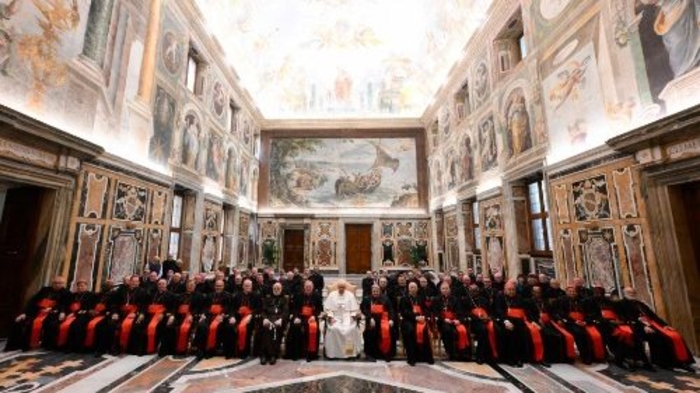
Pope Francis on Wednesday met with members of the Vatican’s Dicastery for Divine Worship and the Discipline of the Sacraments, as they gathered for their plenary assembly.
The Holy Father opened his discourse by noting that, even sixty years after the promulgation of the Sacrosanctum Concilium, it is still highly relevant. It contains, the Pope said, "a precise will to reform the Church in its fundamental dimensions: to make the Christian life of the faithful grow more and more every day; to adapt the institutions subject to change better to the needs of our time; to foster that which can contribute to the union of all believers in Christ; to reinvigorate that which serves to call all to the bosom of the Church”.
This is therefore a profound work of spiritual, pastoral, ecumenical and missionary renewal, said the Pope, adding that the Council Fathers were aware that “without a liturgical reform there is no reform of the Church”.
Pope Francis then went on to explain that Church reform depends on the Church’s love for Christ, like “spousal fidelity”, to the point of being fully conformed to him.
The Church As Woman
Speaking of the role of women in the Church, Pope Francis stressed the importance of the Church itself being a woman. “That is why I said that every instance of Church reform is always a matter of spousal fidelity, because she [the Church] is a woman”, he said.
The purpose of the liturgical reform - within the broader framework of the renewal of the Church - is precisely to "bring about that formation of the faithful and promote that pastoral action which has the sacred Liturgy as its summit and its source", the Pope said.
Pope Francis went on to note that although liturgical formation is necessary, “it does not exclude that there is a priority in the formation of those who, by virtue of the sacrament of Orders, are called to be mystagogues”, that is, the Pope explains, a teacher of mysticism.
A Joint Effort
In the spirit of synodal collaboration between the dicasteries, Pope Francis expressed his desire that the question of liturgical formation of ordained ministers be handled