HOW NAMI-ORLANDO HELPS YOU TO FIND SUPPORT FOR EATING DISORDERS & ANXIETY ATTACKS; PLAN AHEAD OF HOLIDAYS! (1242 hits)
For Immediate Release From NAMI-Greater Orlando, FL!
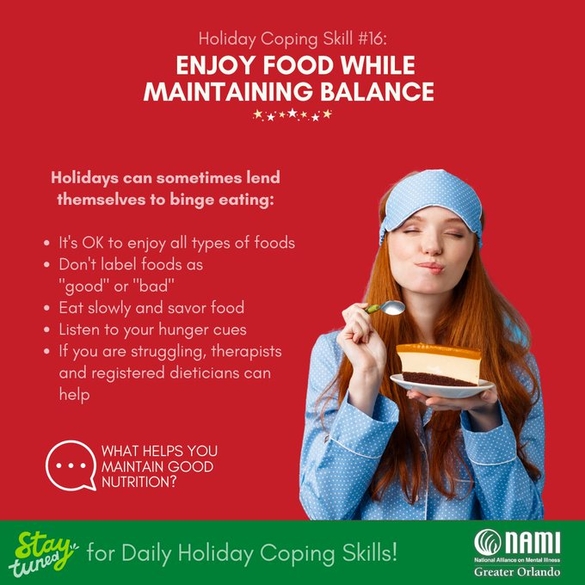
Enjoy Food While Maintaining Balance. Balanced eating can be hard during the holidays. Use these tips to help. If you are struggling with disordered eating, check out NEDA:
Contact the NEDA Helpline for support, resources, and treatment options for yourself or a loved one who is struggling with an eating disorder. Helpline volunteers are trained to help you find the support and information you need. Please note that our Helpline is not a substitute for professional help. We cannot provide any kind of advice or ongoing support. We are happy to listen to your concerns, provide information on eating disorders, help you locate professional help, and explore support options. Reach out today!
You can always leave a message for the Helpline if it is not currently available, and we will return your call or message promptly.
Crisis Text Line
If you are in a crisis and need help immediately, text “NEDA” to 741741 to be connected with a trained volunteer at Crisis Text Line. Crisis Text Line provides free, 24/7 support via text message to individuals who are struggling with mental health, including eating disorders, and are experiencing crisis situations.
Holiday Closure Information Saturday, January 1, 2022 (New Years Day) Monday, January 17, 2022 (Martin Luther King Jr. Day) Monday, May 30, 2022 (Memorial Day) Monday, July 4, 2022 (Independence Day) Monday, September 5, 2022 (Labor Day) Thursday, November 24, 2022 (Thanksgiving Day) Friday, November 25, 2022 (Friday after Thanksgiving) Sunday, December 25, 2022 (Christmas Day) Monday, December 26, 2022 (Christmas Day observed)
NEDA Resources:
NEDA offers support options to individuals and loved ones affected by eating disorders to provide them with support throughout the treatment and recovery process. These programs are not replacements for professional help, and are designed and operated with the aid of NEDA Clinical Advisors to be used as a helping hand while navigating eating disorders recovery.
These listed resources are for your reference only and are not recommendations. We have listed resources based on information provided to us by each resource. We do not confirm the accuracy of the information given to us by any resource. NEDA is a nonprofit organization and does not endorse or recommend any particular resource, nor do we make any judgment about the quality of care given by any resource. NEDA is not responsible for any damages arising from the conduct of any resource listed on the site.
WHERE DO I START?
You've decided it's time to seek help and we're so glad you did. NEDA is here to support you on your journey. These resources can help you take the first step to getting the help you deserve.
WHAT ARE THE WARNING SIGNS AND SYMPTOMS OF AN EATING DISORDER?
The chance for recovery increases the earlier an eating disorder is detected. Therefore, it is important to be aware of some of the warning signs of an eating disorder: https://www.nationaleatingdisorders.org/wa...
HOW DO I KNOW IF IT’S TIME TO GET HELP?
Our online eating disorders screening assesses warning signs of an eating disorder and help you determine if it's time to seek professional help. But please note, this screening is not a replacement for clinical evaluation: https://www.nationaleatingdisorders.org/sc...
HOW DO I OPEN UP ABOUT MY ISSUES?
If you are able to recognize disordered eating attitudes and behaviors in yourself, you have already taken the first step toward a happy, healthy, balanced way of life. The second step—telling a trusted friend, family member, or professional counselor/nutritionist—is equally as important.
The relationship between anxiety and heart disease is a complex one. In some cases, anxiety disorders can be one of the causes of heart disease, triggering, or worsening symptoms. In others, heart disease and its symptoms can cause patients great anxiety. And for some patients, it can be difficult to tell whether the symptoms they are experiencing – such as a fluttering or racing heart – are caused by anxiety or heart disease. In the words of Dr. McCann, the director of the Anxiety Disorders program at John Hopkins Hospital,
“Anxiety disorders can play a major role in heart disease. I believe that a careful look at anxiety would reveal the ways it can severely impact heart disease, both as a contributing factor and as an obstacle to recovery.”
In other words, anxiety can be both a cause and an effect of heart disease.
Anxiety as a Cause of Heart Disease There is mounting evidence that anxiety can cause heart disease. For instance, patients with generalized anxiety disorder seem to be more likely to experience a heart attack or another cardiac event. According to a report by Harvard University, there are many reasons why anxiety might trigger heart issues:
Anxiety sends the body into fight or flight mode. Over time, a disproportionate level of stress response causes system inflammation, which in turn can damage the arteries of the heart, increase blood pressure, or disturb the normal rhythms of the heart. People with anxiety disorders frequently have lower levels of Omega 3s in their bloodstream, and a shortage of these important fatty acids can be associated with heart problems. Anxiety appears to affect the platelets of the blood (tiny blood cells used in clotting), making them more viscous, and therefore, more likely to cause clots and blockages. Anxious people are more likely to adopt unhealthy habits, such as smoking, drinking to excess, or overeating, to cope with the feelings of anxiety – and these habits are all associated with higher levels of heart disease. Anxiety After Heart Attacks On the other side of the equation, it is very common for patients with heart disease to report feelings of anxiety. This is especially the case with people who have experienced a heart attack. The British Heart Foundation reports that 15% of people experience severe depression after a heart attack, and a further 25% suffer from milder forms of depression and anxiety. Some experience post-traumatic stress disorder, a form of anxiety characterized by flashbacks to the event, and intrusive thoughts about its possible recurrence.
Panic Attacks and the Heart:
In some cases, people may struggle to tell the difference between a heart attack and a panic attack. This is not surprising, as the two experiences can be somewhat similar – both often involve a racing heart, shortness of breath, and even chest pain. However, there are also significant differences between panic attacks and heart attacks, as illustrated in this chart from Medical News Today: