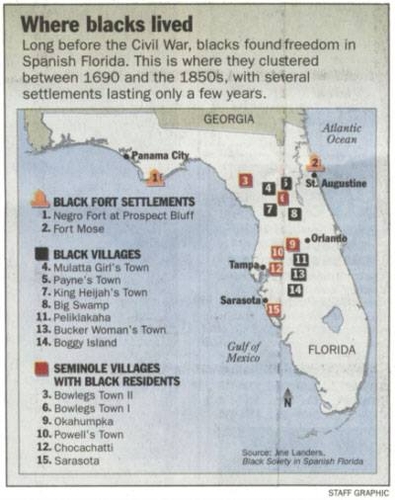
blacks found freedom in Spanish Florida. This map shows where they cluttered between 1690 and the 1850's. (2429 hits)
see pic ,Long before the Civil War, blacks found freedom in Spanish Florida. This map shows where they cluttered between 1690 and the 1850's. -------------------- Click to Listen and Learn more on The Gist of Freedom Sunday at 8pm with historian, Dr. Gilbert Raiford
Enslaved blacks escaped to Florida some believe they were in Florida before the Seminoles. In the late 1600s, Africans who escaped Carolina plantations and dodged slave hunters through dangerous Indian country gained freedom by crossing the St. Mary's River, an international border that divided Spanish and British colonial territory. This was one of the first underground railroad tracks.
So many fled here that, in 1693, the Spanish settlement at St. Augustine began freeing the runaway slaves if they agreed to convert to Catholicism and protect the northern border from the British, according to Jane Landers, author of Black Society in Spanish Florida. By 1738, these former slaves formed the first free black community in North America - Gracia Real de Santo Teresa de Mose - better known as Fort Mose. Soon, the Indians followed. They were the remnants of the most resistant tribes, the Creek, Hitichi, Yamasee and Miccosukee, Indians who had been fighting the Europeans for centuries. Together they became known as the Seminoles. The term first appears in the mid-1700s and is believed to come from the Spanish word meaning "runaway" or "secede." Like the Spanish, the Seminoles harbored runaway slaves. Although most blacks were technically governed by Seminole chiefs, they were free in every other way. They were armed. Most lived in their own villages and, as a kind of tax, gave corn to the tribe. They taught the Indians to build homes, tend livestock and speak English and Spanish. "I don't think some modern U.S. audiences can get that neither the Spaniards nor the Seminoles nor the blacks themselves considered them slaves - only the Americans did," Landers said. They became farmers, ranchers, cowboys, interpreters, hunters, traders and warriors. Some lived short, brutish lives as outlaws, raiding plantations, recruiting blacks, and trading in contraband. Others farmed and traded, building peaceful relations with Indians, slaves, and former masters. Intermarriages were common.
Forty-five minutes west of Walt Disney's make-believe history, archaeologists dig for real artifacts. Hunched over a shallow, square excavation, they search for Peliklakaha, the largest Black Seminole village, Fort Mose known to historians, a place where different cultures joined in a fight for freedom more than 200 years ago. Until now, say University of Florida archaeologists, Peliklakaha existed only in the writings of military leaders and a painting commissioned by the U.S. general who had burned it down.
Archaeologists hope to unearth clues that documents can't provide, secrets about the life of a hidden people. They hope Peliklakaha will reveal whether the inhabitants developed a unique lifestyle with their new status as free people in Florida. "The story of the Black Seminoles is a tremendous story about a successful effort by slaves gaining their freedom before the Civil War," said Delray Beach archaeologist Bill Steele, who discovered the site in 1993. "That's why Peliklakaha is so significant." The dig could establish a new focus in archaeology on cultures that combine African and Native American influences, said Terry Weik, the UF graduate student heading the excavation. It could also bolster the Black Seminoles' lawsuit that seeks a share of the $56 million the United States government paid the Seminoles for reparations. To win their suit against the U.S. government, the Black Seminoles must prove they owned land in Florida. The story of the Black Seminoles is complex and controversial. Often it's misunderstood. The Seminoles themselves were a distillation of as many as 36 tribes. Osceola, the bold and dashing Seminole leader for whom the Florida State University mascot was named, was half Scottish and half Creek Indian, and married a Black Seminole. — with DeWanda Yvette Baugh.