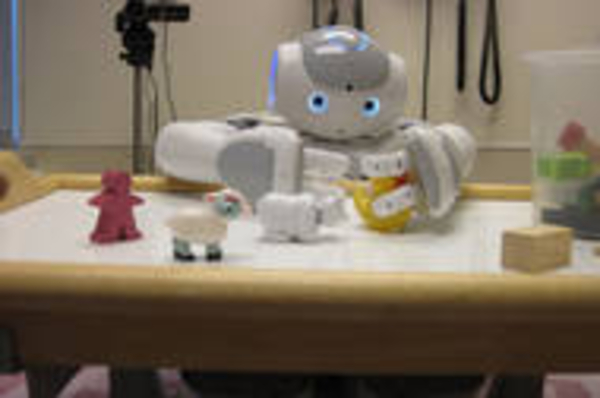
Health care workers have a new tool to ease needle anxiety in children: a talking robot. The robot, named MEDi, is programmed to greet a child with a high-five, collect toys from a tray and ask questions like “Do you like movies?” Children who engaged with the robot while receiving a flu shot had much less pain and distress than children who got a shot the usual way, according to a study published in the June issue of Vaccine.
“It’s the first robot to help children manage painful medical procedures,” said Tanya Beran, a professor of community health sciences at the University of Calgary in Alberta and the principal investigator of the study, which was conducted at Alberta Children’s Hospital. Research suggests that children who experience distress in a medical setting at a young age are less likely to access health care in adulthood, so she says it’s important to find ways to reduce pain during pediatric care.
For the study, Dr. Beran and her team recruited 57 boys and girls, ages 4 to 9, who had a moderate to severe fear of needles. Many had chronic medical conditions and had been to the hospital before. And many had vomited, fainted, run out of a clinic or needed to be restrained by nurses or parents when undergoing shots or other medical procedures. ...“The robot was distracting the child during distress, but also giving instruction for how to cope,” said Dr. Beran. “Deep breathing relaxes the deltoid muscle.”
The robot is made by a French company, Aldebaran Robotics, and is sold under the name NAO for about $15,000. The Calgary researchers called theirs MEDi, short for Medicine and Engineering Designing Intelligence. Other research teams have programmed the robot for such applications as elder care, providing reminders to take medications and demonstrating yoga poses; leading a classroom game to teach students multiplication tables; and, in one Milan hospital, serving as a companion to children with diabetes. But as far as pain relief in pediatric patients, “no one in the world has done this before,” said Dr. Beran. “You’re creating a new area of research that people will start to work in.”