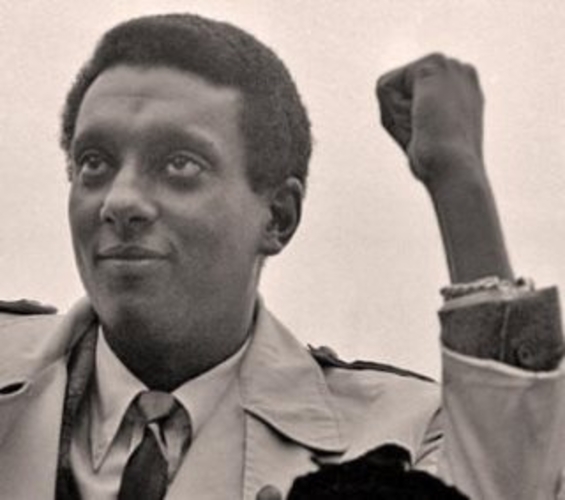
Stokley Carmichael) is widely regarded as the architect of the term “Black Power (1338 hits)
This is the twenty-seventh time I have been arrested and I ain’t going to jail no more! The only way we gonna stop them White men from whuppin’ us is to take over. What we gonna start sayin’ now is Black Power ! see the video of Old Footage of a Young Stokely the brother is deep !
It started with a dignified, matronly lady refusing to give up her seat on the bus, and it ended with more than 100 cities aflame.
Martin Luther King did not launch the 1955 bus boycott in Montgomery, Alabama, but he soon emerged as its champion and the leader of the civil rights movement that it spawned. Eight years and many, many demonstrations later, Martin Luther King would give forth with his “I Have A Dream Speech,” in the 1963 March on Washington which would yield the 1964 Civil Rights Law and the 1965 Voting Rights Act.
But also in 1965, Malcolm X was killed. Malcolm X was the antithesis of King. Whereas King advocated non-violent opposition to achieve integration, Malcolm proclaimed separation, self-sufficiency and self-defense. Malcolm’s fame increased dramatically after his death, especially in the North which had long been integrated, but African Americans there were still shut out of the economic mainstream, and police violence was sharply on the rise.
Starting in 1964, America’s Northern cities in summer would, one-by-one, explode as Black communities fought back against the police and put businesses to the torch. Meanwhile, Black college students, fresh from civil rights campaigns, came streaming northward to organize and direct the growing, angry protests.
Said Stokley Carmichael after one particularly stormy demonstration, “This is the twenty-seventh time I have been arrested and I ain’t going to jail no more! The only way we gonna stop them White men from whuppin’ us is to take over. What we gonna start sayin’ now is Black Power!” Soon the organization which he led, the Student Nonviolent Coordinating Comminttee (SNCC) became involved in a series of protests that were anything but. Around the same time Harlem Congressman, the Rev. Adam Clayton Powell railed against Black oppression declaring, “To demand these God-given rights is to seek Black Power.”
Before long “Black Power” became the slogan behind a broad-based, insistent push for equality, at any and all costs. The Black Panther organization came on the scene, armed themselves and engaged in battle with the police, even as they fed schoolchildren and encouraged literacy and self-expression.
Black writers formed the Black Arts Literary movement to inspire and document the dramatic change in attitude. They avidly fostered the then novel idea that “Black is Beautiful!” and thus was forever shed the terms “negro” and “colored,” as “Black” became the defining moniker. Meanwhile, Black students launched fiery protests on college campuses across the country demanding that the curriculum be broadened and their numbers increased.
The summer of 1967 became particularly tumultuous after Newark and then Detroit combusted in a prolonged, deadly conflagration. President Johnson immediately set up the National Advisory Commission on Civil Disorders. Seven months later on February 29, 1968 it released its report concluding that “Our nation is moving toward two societies, one Black, one White—separate and unequal.” It also charged that “(t)he press has too long basked in a White world looking out of it, if at all, with White men’s eyes and White perspective.”
It identified racial discrimination in housing, education and employment as the primary causes of the upheavals. Martin Luther King hailed the report as a “physician’s warning of approaching death, with a prescription for life.” Five weeks later, however, Martin Luther King himself was shot to death in Memphis, Tennessee. There immediately followed spontaneous riots and rebellions in every major American city. Whereas in the past the uprisings were localized, now they took place everywhere simultaneously.
In an attempt to quiet what was shaping up as a Black Revolution, in the months and years ahead, Affirmative Action programs vastly increased the number of African Americans in college and in middle management positions in the economy and college authorities acquiesced to student demands for programs and departments of Black Studies. The Black Power movement ignited numerous other movements for equality including the Women’s Movement, the Native American movement, the Gay Rights movement and the Puerto Rican Liberation movement, just to name a few.
Over time, the protests eased as the Black middle class substantially expanded, but the poor and working class nonetheless remained, but shorn of their leading elements which had become incorporated into the mainstream. Eventually, Affirmative Action itself was eviscerated and though the Black middle class would protest, cut off from its base, its cries would fall on deaf ears. Meanwhile, police repression resumed and the prison population zoomed.
And so where are we today? Formal segregation is gone, access to the middle class has increased, but our cultural and psychological condition and confidence has waned. Where do we go from here, that is the question. Meanwhile, let us remember our past as we ponder our future. This essay is a brief reflection on those heady days when we launched and piloted the Civil Rights movement which eventually morphed into the Black Power struggle. We still live in the aftermath and the shadow of those enduring accomplishments. When shall we rise again?
By: Dr. Arthur Lewin
Dr. Lewin was born in Harlem, New York. His parents hail from Jamaica and Cuba. His research has included topics in Jamaican political history, charismatic leadership in African America, Africa and the Caribbean and the class structure in Black America. He is the author of the popular book Africa is Not a Country its a Continent!
Massive love onto you with your video clip of our dynamically hero, Baba Kwame Ture. Baba Kwame Ture was so inspiration, he is our solder and hero who showed defiance in uniting Africans on the planet earth. Baba Kwame wasn't evil, because like all of us, he was the victim of racial injustice and he showed us to not be intimidated of them. Baba Kwame Ture also be proud of who we are without any fears or favours. Long live, Baba Kwame Ture.
Sunday, June 9th 2013 at 12:57PM
DAVID JOHNSON