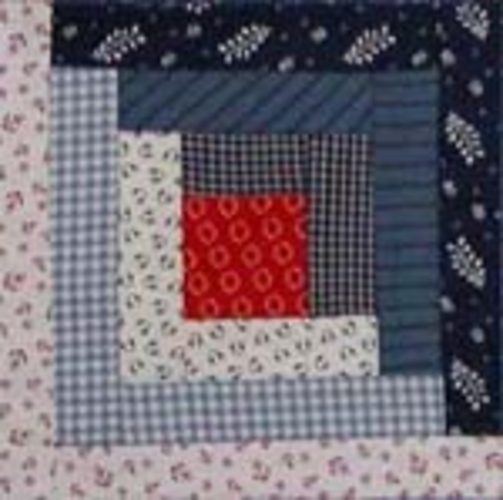
There are intriguing stories of how quilting was used to help the slaves escape through the Underground Railroad. A Log Cabin quilt hanging in a window with a black center for the chimney hole was said to indicate a safe house. Underground Railroad quilts, a variation of Jacob's Ladder, were said to give cues as to the safe path to freedom. We imagine women secretly sewing fabric pieces together to be used as signals.
It is disappointing to learn that research on the Underground Railroad has found no evidence that this actually occurred. But these stories have been told from generation to generation filling our imagination with visions of quilting being a part of the flight for freedom. 1 While we enjoy these stories it is important to be aware that it is unlikely that quilts were ever used in the Underground Railroad.
In her article on the Underground Railroad block Barbara Brackman tells us, "As a quiltmaker I've always loved the pattern and the secrets hidden in the name. But as historian I've come to realize that there are no known quilts in this pattern dating back to the days of the Civil War or to the decades before the War when the Underground Railroad flourished." 2 This block was first known as Jacob's ladder, another reason to wonder if it was simply renamed later in honor of the brave souls who ran for freedom and those who helped them.
Abolitionist Quilting for Fairs What we are certain of is that in the north women made quilts sewing inscriptions on them indicating the evils of slavery. Some even included a sketch of a slave in shackles. The following antislavery poem was inscribed on one of them..
"...I'd sooner spend my days within Some dark and dismal cave Than to be gulilty of the sin Of holding one poor slave." 3
As early as the 1830s abolitionists were actively pushing for antislavery laws. They hosted many handicraft fairs over the years to raise money for their cause and to keep it in the public eye. Women used their sewing skills to make various items including clothing, decorative items, afghans and quilts of fine fabric for these fairs. "The first Anti-Slavery Fair was held in Boston in 1834, and it was so successful the idea spread to other cities and towns throughout New England, and then to other states such as Ohio and Pennsylvania." 4
Female Anti-Slavery Societies were formed by freed black women and white women. These organizations circulated petitions, provided schools for black children and raised needed money. In 1834 the abolitionist journal, "The Liberator" reported on an Anti-Slavery Fair. The article mentions, "We are told the colored ladies of Salem particularly deserve thanks for the interest they took in the Fair, and the articles they sent." 5 These abolitionist activities had a powerful influence on events leading up to the war. http://www.womenfolk.com/quilting_history/...
Quilting was one way families would remember love ones and it's art form is amazing since the cloths were once clothing that some would wear like a dress, shirt, skirt or pants. My mother quilts included some of things she used to wear. It's a excellent memory of loved one. Thanks for this interesting blog I found it be be very touching.
Tuesday, February 1st 2011 at 8:17PM
MIISRAEL Bride