Editor's note: Shahira Amin was deputy head of Egyptian state-run Nile TV -- and one of its senior anchors. After 22 years with the network, angered by its censorship of the Egyptian revolution, she quit on February 3 2011.
Cairo, Egypt (CNN) -- When Iman Abdella steps out of a black-and-white Cairo taxi in Haggana, residents of the impoverished quarter rush to greet her with jubilant cries and trilling zaghareet. "Alf marhaba (welcome a thousand times)," cries Soad Bekheit, a shabbily dressed mother of four, opening her arms to embrace the familiar visitor. "It's as if the Prophet himself has visited us today." For the families in this desolate ghetto, one of Cairo's poorest, a visit from this woman in a traditional Islamic head scarf means they will not have to go to sleep on an empty stomach -- at least, not tonight.
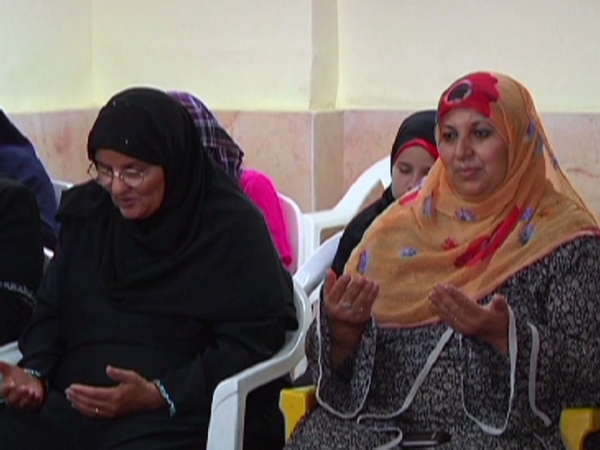
Abdella is on one of her charity missions -- part of her work as a devoted member of the Muslim Sisterhood, the female division of the Muslim Brotherhood, Egypt's oldest and largest opposition group. She visits Haggana at least twice a month to distribute relief bags among the needy families: "I have been doing charity work ever since I joined the group 17 years ago as a student at Al Azhar University," she says. Each bag contains a frozen chicken, a kilo of sugar, a bag of rice, flour and a pack of lentils.
Gallery: The sisters of the Muslim Brotherhood "It's not much," she says. "But I hope to be back with more before Ramadan."The Muslim fasting month -- just round the corner -- is traditionally a time of "zakat" or alms-giving.
"People in this neighborhood need basic necessities," Abdella says. "Residents in slum areas like Haggana have long been forgotten ... that is why we had a revolution. "The mass uprising in January was about social justice and giving people back their dignity." For years, the Islamist Muslim Brotherhood movement has won over Egypt's poor and working classes with charity work -- stepping in to provide many of the services that the former government did not provide, like subsidized healthcare.
And the women of the Sisterhood (the name for female members of the Brotherhood) have traditionally been more involved in welfare activities than their male counterparts. These range from small-scale social work like organizing the collection and distribution of alms to building mosques and schools. The Islamists have also established numerous benevolent institutions such as hospitals, pharmacies and clinics targeting Egypt's downtrodden and forgotten.
The Sisterhood's charity work has, for years continued to attract new recruits from across the country -- particularly vulnerable unemployed youths -- allowing the movement to steadily gain strength despite long years of suppression under former President Hosni Mubarak's regime. [...]
In recent years -- and increasingly so since the January mass uprisings -- the Ikhwan have tried to shake off their past fundamentalist image and sell themselves as moderates and reformists. But some Egyptians aren't buying it. "The Muslim Brotherhood are not to be trusted. They are just after a power grab," says Ramadan Ismail, a mechanic in the working-class district of Imbaba.
That is a view that is shared by laymen and analysts alike in Egypt -- and this is not a surprise after the massive show of support by the Brotherhood for radical Brotherhood ideologue Sheikh Qaradawi when he addressed tens of thousands of opposition activists in Tahrir Square during the February uprisings. Qaradawi has a long record of inciting violence against Jews and Israel. During a sermon aired on the Arabic satellite channel Al-Jazeera in January 2009, Qaradawi told his audience, "I will shoot Allah's enemies, the Jews, and they will throw a bomb at me, and thus I will seal my life with martyrdom."
Meanwhile the Brotherhood continues to attract new recruits with its slogan: "Islam is the solution" -- among other incentives. [...] Women who attend the Brotherhood's Quran recitation and interpretation classes receive between 40 and 100 Egyptian pounds ($7 - $17) a month. The money, according to Abdella, comes from "an Islamic Association outside the country," but wouldn't say which one. There have been unconfirmed reports of Gulf non-profit organizations pouring enormous amounts of cash into spreading Wahhabi influence in Egypt and other Arab countries. Wahabbism or Salafism is an ultra-conservative form of Islam that is the dominant faith in Saudi Arabia. It has been linked to extremism. It's a long-standing source of concern for secular Egyptians.
It may, in the end, be the Sisterhood who provide the change of image the organization is looking for. ...