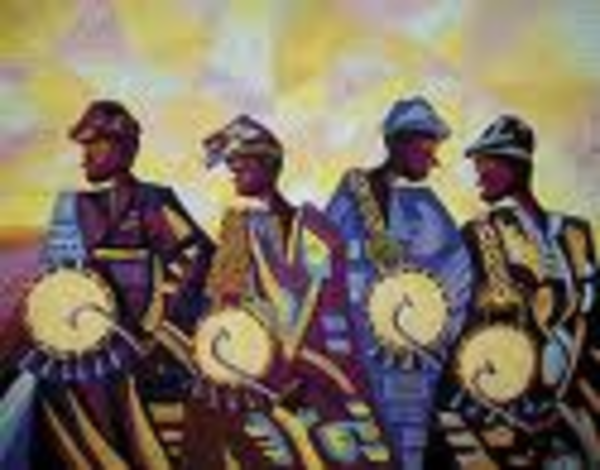
Ijo Fuji Remix Dedicated to My Friend & Brother, Robert Powell. (1376 hits)
Adewale Ayuba, with stage name Ayuba was born on May 6, 1966 in lkenne Remo, Ogun State, Nigeria. He grew up as a child singer... http://en.wikipedia.org/wiki/Fuji_music
I dedicate this Fuji track to you because just as this track is succinctly mixed with various musical styles and genres from around the world, you my friend are also filled with a wealth of knowledge and various experiences. I'll always remember your lively presence and colorful use of adjectives that angered some and made many others laugh. Take care my friend and know that your inspiration and friend, Jen "the Juicy Fruit" Fad will miss you! ((Hugs))
Fuji is a popular Nigerian musical genre. It arose from the improvisation Ajisari/WERE (Pronounced We're-Ray) Music Tradition, which is a kind of Muslim music played by the Muslim kids in Yorubaland before dawn to wake the faithful believers for Ramadan fasting season. WERE Music/Ajisari itself was made popular by the likes of Alhaji Dauda Epo-Akara, the deceased Ibadan-based "awurebe" founder and Ganiyu Kuti or Gani Irefin.
Fuji Stylistic origins: WERE MUSIC Cultural origins: 1960s Nigeria Typical instruments: Drums - harmonica - vocals Mainstream popularity: Some worldwide attention since the 1970s http://en.wikipedia.org/wiki/Fuji_music
Ijo is Located in Southern Nigeria and has a Population: 200,000 Language: Ijo (Kwa) Neighboring Peoples: Ibgo, Yoruba, Ewe
Types of Art: Ijo are best known for their extensive production and alteration of cloth. Dress is used to signify status throughout society. They also produce wooden sculpture and memorial screens to commemorate their ancestors.
History: The geographic conditions of the Niger Delta region have resulted in the Ijo being located astride trade routes throughout the region. Routes connecting them to other west African groups were established at least as early as the 15th century.
In the 1600s the Ijo served as intermediary slave traders between Europeans and African groups to the north of them. Due to their central location, the Ijo have appropriated many outside ideas into their own expressive culture. This is most significantly expressed in Ijo fashion choices. In recent years many Ijo have moved to Port Harcourt in search of employment, but many of the wealthy still maintain residences in their homelands.
Economy: The Ijo rely largely upon their relationship with the rivers and ocean for their survival. They depend on trading goods and fishing to supplement farming and hunting. Yams and processed palm oil are produced in large quantities for outside trade. Women normally participate in large market systems where people trade and sell wares for pleasure, as well as survival. Wealth is often redistributed through the institution of dowries. Usually bride prices paid to people outside the immediate community are larger, to compensate the bride's community for the loss of her children who will remain in the village of the husband. Those who live in Port Harcourt, the capital of the region, often work as professionals, traders, and civil service workers.
Political Systems: Peoples from eastern Ijo territory traditionally lived in compact villages and towns that were politically integrated through a system of chiefs who were family or clan heads. High status is normally awarded in accordance with elaborate hierarchical systems and often results only after payments have been made to those already holding titles. Peoples from western and central Ijo territory acknowledged no central political authorities until the British arrived.
Religion: Ijo traditional religion centers around water spirits who inhabit the numerous rivers and swamps of the area. Tribute is also paid to ancestors who are often represented in wooden shrine figures or memorial screens known as Nduen Fobara by Kalibari Ijo.
Funeral ceremonies among the Ijo are often quite dramatic, with greater attention afforded to members of the community who have reached a combination of advanced age and high prestige. Extensive funerals are held for both women and men in preparation for sending them on their final journey away from the village to the spirit world across the river.
How refreshing Jen! I really enjoyed this, and I know Robert will too. He hasn't left the site yet. But I believe the restriction on how one can or cannot express themselves would put a damper on anyone. I will make sure he knows you've posted this.
Tuesday, September 21st 2010 at 8:33AM
Adam Fate
Hey Jen:
Nice!!!!
Any time someone supports, builds, enlightens, educates or makes us smile---well that is a good thing.
Jen, I know this is your blog, but it's hard to me to feel the same grief you and Adam are feeling. I am just glad that he is not longer a threat...
Tuesday, September 21st 2010 at 12:57PM
Siebra Muhammad
P.S. What goes around comes around...
Tuesday, September 21st 2010 at 12:58PM
Siebra Muhammad
I like to bring the same kind of flavor that Brother Rob has brought to the blogs by the musical variations in this song and it helps that it has Islamic roots. I do understand that although he has a way with adjectives that have been offensive to some, but to others they have been entertainment at the expense of others which I do not in way condone. I just wish we could express ourselves like the artist in this song has chosen to do so with such rhythmic vibration that makes anyone forget about their challenges. Just my two cents...
Tuesday, September 21st 2010 at 2:49PM
Jen Fad
Let's probe. What is your real name, Saint Jake? Who is that hiding, another EDOMITE, working for the government maybe?
Tuesday, September 21st 2010 at 5:44PM
Adam Fate
Is this site for only Black people?
Tuesday, September 21st 2010 at 9:44PM
Jen Fad