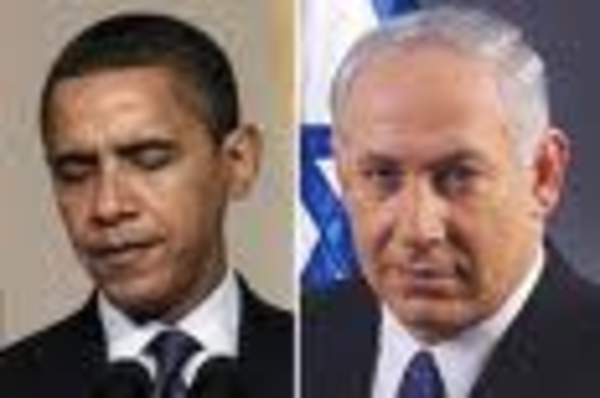
President Obama Meets Netanyahu as Peace Talks Begin (626 hits)
WASHINGTON — President Obama on Wednesday began the arduous process of coaxing and pressing the main Middle East participants to define and embrace a comprehensive peace settlement. But he had to begin by joining Prime Minister Benjamin Netanyahu of Israel in strongly condemning a fatal attack on the West Bank and declaring solemnly, “We’ve got a lot of work to do.”
The meetings on Wednesday and Thursday will end 20 months without direct negotiations between the core participants. President Obama’s one-on-one meeting with Mr. Netanyahu in the White House Oval Office — to be followed by meetings between the president and, successively, President Mahmoud Abbas of the Palestinian Authority and the Jordanian and Egyptian leaders — began under the cloud of the violent attack Tuesday on the West Bank, claimed by Hamas militants, which left four Israeli settlers dead.
President Obama angrily denounced the killings as a “senseless slaughter” by “terrorists who are purposely trying to undermine these talks.
“But,” he said, “we are going to remain stalwart.”
The violence, President Obama said, underscored the need for talks that would help assure the security of Israel. Mr. Netanyahu, standing next to President Obama in the Rose Garden, in turn blamed people who “trample human rights into the dust and butcher everything that they oppose.”
The Palestinian Authority has detained scores of suspects in the killings, and President Obama took pains to emphasize that Mr. Abbas, too, had condemned the violence.
“I have the utmost confidence in him and his belief in a two-state solution in which the people of Israel and the Palestinians are living side by side in peace and security,” the President said, “and so I’m also grateful to him for his presence here today.”
“The message should go out to Hamas and everybody else who is taking credit for these heinous crimes that this is not going to stop us from not only ensuring a secure Israel but also securing a longer-lasting peace in which people throughout the region can take a different course,” President Obama added.
Mr. Netanyahu said that it is important that the peace talks include looking at how to ensure Israeli security. “That is a fundamental element, an important foundation, of the peace that we seek and work for.”
Against that backdrop, the bilateral meetings begin a two-day series of intensive encounters between the leaders. They include a working dinner on Wednesday hosted by President Obama in the White House’s Old Family Dining Room, whose soft yellow walls and curtains provide a more intimate setting than the State Dining Room.
Along with President Obama, Mr. Netanyahu, Mr. Abbas, President Hosni Mubarak of Egypt and King Abdullah II of Jordan, the guest list includes the former British prime minister, Tony Blair. He will attend in his capacity as special envoy of the Middle East Quartet, which consists of the United States, Russia, the United Nations and the European Union.
On Thursday, the talks will move to the State Department, where they will transpire under the eye of Secretary of State Hillary Rodham Clinton.
“We’ve gone 20 months without that direct negotiation,” Philip J. Crowley, a State Department spokesman, said Tuesday. “We’re not going to solve everything on Thursday. What we want to see is the — is a commitment to aggressively, you know, pursue these negotiations.”
He continued: “We will do our part. We expect the leaders to do their part.”
President Obama’s own envoy to the Middle East, George Mitchell, said Tuesday that he believed the Israeli and Palestinian leaders saw a “window of opportunity” for peace despite the deep challenges that for decades have defied efforts at solution.
Mr. Mitchell said that the world stood at “a moment in time within which there remains the possibility of achieving the two-state solution, which is so essential to comprehensive peace in the region.”
The leaders in Washington face a series of intractable problems, but most immediate is the question of whether Israel agrees to extend a partial moratorium on construction in the West Bank that expires Sept. 26. Mr. Netanyahu has steadfastly rejected any extension, while Mr. Abbas has said that any hope for the talks would be seriously damaged if construction resumes.
Observers looking for hints of progress will have a chance to parse President Obama’s words on Wednesday afternoon. He is scheduled to make remarks from the White House Rose Garden at 5:20 p.m.
Then, at 7 p.m., all the leaders are slated to make statements from the White House East Room. They move an hour later to a dinner that administration officials hope will help begin, at least, to lower the sense of distrust between the main parties.
The peace talks are set to move to the Middle East later this month.