HOW POPE FRANCIS MAKES SURPRISE APPEARANCE AT MASS, RENEWING THE SOUL OF SERVICE, PEACE... (1540 hits)
For Immediate Release From Vatican News!
The Importance Of ‘Presence’ In A Time Of Virtual Reality
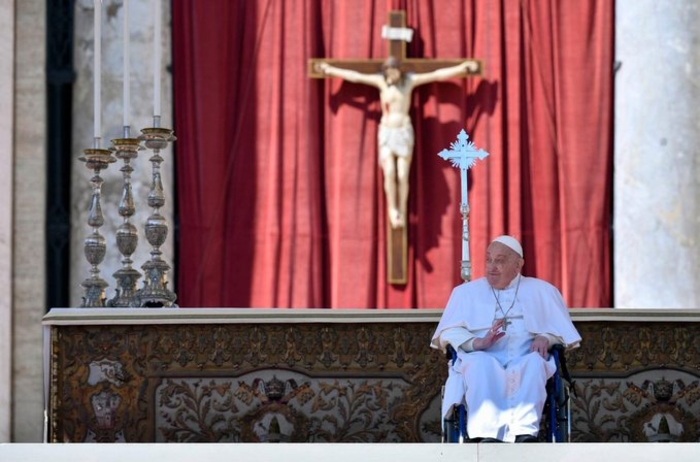
Our Editorial Director reflects on Pope Francis' surprise appearance on Sunday to greet participants in the Jubilee of the Sick and Health Care Workers. By Andrea Tornielli
The unexpected appearance of Pope Francis in the final moments of the liturgical celebration for the Jubilee dedicated to the sick and healthcare workers represents a message full of meaning.
Even in the time of virtual reality, in the time when we believe we can participate in everything from behind a computer screen, being physically present is very important.
To be there in person, to make the effort to travel, to go out, to wait; to make the effort to walk, to get close to others, to sweat, to expose oneself to the sun or the elements, makes it possible to meet the gaze of those around us in person, to experience the company of others, to be part of a pilgrim people.
With his unannounced appearance on Sunday, the Successor of Peter teaches us that nothing can ever really replace physical presence, being there.
The Pope's appearance in front of St Peter’s Basilica is therefore in itself a message more significant than any words: despite his still feeble voice, despite the oxygen tank, he wanted to be there.
Then there is a second meaning: for his first public appearance after being released from Gemelli Hospital, Pope Francis chose a Jubilee celebration that he feels particularly close to: one dedicated to the sick, to those who suffer, and to those who care for those who suffer.
Although the worst is over, the Pope is a convalescent who still shows the signs of illness. Frail among the frail, he has not given up living “his” Jubilee, confessing in the Basilica and going through the Holy Door as thousands do every day.
On Sunday, he came as a simple pilgrim still suffering the consequences of pneumonia, crossing the threshold of the same Holy Door he himself had thrown open wide on Christmas night.
Finally, Sunday morning’s surprise appearance speaks to us of the pastor’s relationship with his flock and of the bishop with his people.
Despite his convalescence, despite the doctors’ warnings, Pope Francis has not given up meeting with people, even though he is aware of the risks to his health this may entail.
In doing so, he shows us that even though circumstances may sometimes dictate a “virtual” approach due to hospitalisation, lockdown due to the pandemic, or inability to travel, an in-person encounter is irreplaceable. For, as he said a little over a year ago, “love needs tangibility; love needs presence and encounter; it needs to be given time and space; it cannot be reduced to beautiful words or to images on a screen…”
This applies, too, to the Pope’s love for the people of God, to whom he has always “spoken” not in words only but with actions and tenderness.
--In his Angelus message for this Sunday, Pope Francis asks that healthcare workers be supported and respected. He also calls for peace throughout the world, denouncing the violence in Haiti, where two nuns were killed on Monday.
Cardinal Krajewski Brings Pope’s Gift Of 4 Ambulances To Ukraine
Pope Francis has sent his papal almoner, Cardinal Konrad Krajewski, to Ukraine with a gift of four ambulances, which will be used to save lives along the frontlines of the war. By Vatican News
As Ukraine faces another Easter marked by war, Pope Francis continues to show his closeness to the suffering people through concrete gestures—three years after what he previously called “a painful and shameful anniversary for humanity.”
Cardinal Konrad Krajewski, Prefect of the Dicastery for the Service of Charity, has embarked on his 10th mission to Ukraine, at the behest of the Pope and with the assistance of three Ukrainian drivers.
The papal almoner delivered four ambulances to the Eastern European country that are fully equipped with medical devices required to save lives.
A statement from the Dicastery for the Service of Charity, released on Monday, quotes the Pope’s 2024 Urbi et Orbi message as a call to action. “Only Jesus opens the doors to life,” the Pope said, “those very doors we keep shutting with the wars spreading throughout the world.”
Ambulances For War-Torn Ukraine
The four ambulances bear the coat of arms of the Vatican City State and are destined for the areas hardest hit by the war.
Cardinal Konrad Krajewski, the Pope’s almoner, will remain in Ukraine for a few days to be close to the people, to pray with them, and to embody the care and concern of the Bishop of Rome.
Vehicles Bearing The Vatican’s Coat Of Arms
This marks Cardinal Krajewski’s 10th mission to Ukraine and takes place in the context of the Jubilee of Hope.
In the Bull of Indiction for the Holy Year, Spes non Confundit, the Pope writes: “The first sign of hope should be the desire for peace in our world, which once more finds itself immersed in the tragedy of war… The need for peace challenges us all, and demands that concrete steps be taken.”
The Pope’s gift of the four ambulances represents another expression of Jubilee hope anchored in Christ.
********
Jubilee Of The Sick: “Our Role Is To Open A Window On Eternity”
This weekend, Rome is welcoming over 20,000 pilgrims for the Jubilee of the Sick and the Healthcare World. Volunteers from Lourdes tell Vatican News that they hope to strengthen their commitment to the sick and disabled, who flock to the French city in their thousands every year. By Jean-Benoît Harel
A Pilgrimage For Those Who Usually Organize Them.
All year round, the organisation Hospitalité Notre-Dame de Lourdes welcomes pilgrims to the famous Marian shrine in the south of France, with the help of hundreds of volunteers from over 90 different countries.
From April 5 to 6, a group of around 70 people from the Hospitalité is taking part in the Jubilee of the Sick and the Healthcare World in Rome.
“We Are Mary’s Arms”
For Daniel Pezet, President of Hospitalité, this is an extremely important event, as “the mission of the Hospitalité Notre-Dame de Lourdes is to welcome pilgrims to Lourdes, especially sick pilgrims”.
Pezet, originally from Paris but now living near the shrine, says that coming to Rome means plunging deep into his hope of faith and eternal life, in order to then witness it to the sick.
“Through our action, through our smile, through our presence, we enable them to hope, and to open a window on eternity,” Pezet explains.
“We are Mary's arms, Jesus' arms for them. We lend them our eyes, our smiles, to welcome them as best we can,” says Maider Urruty, a native of France’s Basque country, who helps disabled pilgrims immerse themselves in Lourdes’ waters. With Hospitalité, her “second family”, she has come to join in the Jubilee “simply as a pilgrim, as a Catholic”.
At Lourdes, among the 3.2 million pilgrims expected in 2024, some will be non-believers, she says: “We welcome everyone, of all faiths, even people who don't believe in anything, but who are often looking for hope”.
Helena Foy, an Irish woman from Dublin, another long-time volunteer, agrees. “Very often, patients are desperate. We have to try to give them a little hope and tell them: 'even when you're ill, you can live normally, you can carry on'”.
She is very moved to be coming to Rome for the first time, a way of marking the 140th anniversary of Hospitalité Notre-Dame de Lourdes.
Renewing The “Soul Of Service”
Coming to Rome as a pilgrim for the Jubilee of the Sick? “It was a natural fit,” smiles Christiane Varachaud. A nurse, she felt “called” to serve the most vulnerable, both in Lourdes and at her job. Now retired and involved with the Society of Saint-Vincent-de-Paul, she wouldn't miss the regular visits she makes to Lourdes for the world.
“The world changes, but I believe that in our hearts nothing changes”, she says, noting the growing number of people who ask her to pray for them in front of the grotto, or to bring them water from Lourdes.
Accompanying the group of pilgrims, Father Michel Daubanes, rector of the sanctuary, hopes that the hospitaliers on pilgrimage to Rome will be strengthened in their “soul of service”, i.e. “their availability to the little ones, to enable them to experience faith, friendship, spirituality and solidarity. These are extremely precious for people who are ill or disabled, but just as much for those who assist them”.
He is preparing for the busy months ahead, with pilgrimages to Lourdes starting this Saturday, April 5.
While waiting to return to Lourdes for their volunteering, the pilgrims from Hospitalité will take part in Mass in St. Peter's Square on Sunday April 6 at 10:30 a.m. for this seventh major event of the 2025 Jubilee Year.
********
Summit Provides New Impetus For Europe’s Public Radio Stations
The 31st Radio Assembly of European broadcasters, hosted this year in Paris by Radio France, comes to a close with the election of a new steering committee for the next two years. By Vatican News
At a time marked by fake news, international geopolitical tensions, and widespread polarisation within European countries, public service radio can play a fundamental role in defending democracy, according to participants at the 31st EBU (European Broadcasting Union) Radio Assembly, which took place this year in Paris.
Radio stations from no less than 33 countries took place at the summit of European radio broadcasting at the Radio France headquarters in Paris including Vatican Radio, represented by Alessandro Gisotti, deputy editorial director of Vatican Media.
This year’s Assembly saw the election of members of the “Radio Committee,” the body that within the EBU that coordinates strategies and initiatives to strengthen the presence of Radio in an ever more rapidly changing media environment. Sibyle Veil, Director General of Radio France, was reconfirmed as head of the Committee; while the BBC’s Graham Ellis who is also a Consultant of the Holy See's Dicastery for Communication, was re-elected as Deputy Director. Other members of the Radio Committee, which will be in office for the next two years, include Andrea Borgnino, head of RAI Play Sound, in his fourth term on the EBU body.
During the two-day summit in Paris, participants expressed solidarity with colleagues from Ukrainian Public Radio who, despite the war, have never failed in their task of informing the population. The summit also featured appeals in favour of Radio Free Europe, which, like Voice of America, is threatened with closure due to funding cuts imposed by the White House. At the same time, the Assembly reiterated the urgent need for closer cooperation between European public service media in order to defend freedom of the press, which is increasingly at risk due to economic and political pressure.
The Assembly devoted ample space to consideration of programmes for young audiences who, EBU research shows, are very demanding when it comes to information. Members of the younger generations seek news first and foremost on social platforms, but do not spurn radio content (and even more so podcasts) when they are creative and humorous.
Artificial intelligence, with a focus on audio and the possibilities offered by the use of synthetic voices, aroused particular interest, as did the panel on music and its special relationship with radio. Today, 60 per cent of young Europeans consider music to be their main interest; and this opens up great possibilities for Radio, as seen during the dramatic period of the pandemic and the subsequent lockdown. “During Covid,” said Graham Ellis, long-time chairman of Prix Italia, “music was a great comfort to people. Music brings people together and this is also thanks to Radio.”
Concluding the event, Sibyle Veil said that credibility remains the greatest asset of public service media, and in particular of radio. For the Director General of Radio France, technological innovations push radio stations to find new ways of reaching their audiences. She therefore scheduled the EBU General Assembly to be held in July in London, hosted by the BBC.
********
‘The Boy From Milan’: A Retelling of Carlo Acutis’ Story
Ahead of his canonization, a new documentary moves beyond the stereotypes that mark the life of the soon-to-be first millennial saint and focuses on who he was as a boy from Milan. By Kielce Gussie
The story of the young man from Milan, who died at the age of 15 and is now buried in his sweatshirt and sneakers in Assisi, spread quickly throughout the world. From his everyday look to his website dedicated to Eucharistic miracles, people seemed to be able to find something they could relate to.
Yet, beyond the now well-known titles people have given him—the saint in sneakers or God’s influencer—a new documentary strives to break down the stereotypes of young Carlo Acutis and shine light on his life through three different perspectives.
Saints Were Human Too
In an interview with Vatican News, Edmundo Reyes, executive producer of the documentary The Boy from Milan, explains how the crew received the news of Carlo’s canonization while they were filming an interview with his mother, Antonia. “You don't get to talk to the mother of a saint very often,” Reyes exclaims, explaining that she received the call from the Holy See at that moment and shared it with the crew.
********
Pax Christi: ‘Proactive Nonviolence Is The Key To Peace’
Martha Inés Romero, Secretary General of Pax Christi International (PCI), illustrates the Catholic peace organization’s commitment to proactive nonviolence as an effective means to foster peace, citing its work in Latin America. By Rocío Lancho García and Lisa Zengarini
Pope Francis has relentlessly worked to wean humanity from its tragic belief that violence is the solution to conflict, arguing that rather than resolving the great challenges of our time, violence often perpetuates and escalates them.
Echoing his predecessors, he has repeated endless times that "War is always a defeat for humanity." In his speeches, writings, and interviews he has insisted that there is another way than violence to resolve conflict, foster justice, heal the earth, safeguard immigrants, and ultimately end war, all of which are interconnected.
This idea is at the heart of Pax Christi International’s (PCI) mission, a global Catholic peace movement founded in Europe in 1945 bringing together French and Germans after World War II which today has over 100 member organisations active worldwide. The movement seeks to transform a world ravaged by multiple forms of violence—be it physical, structural, or environmental—into one that embraces peace and justice.
Secretary General of PCI, Martha Inés Romero, and previously coordinator of Pax Christi for Latin America and the Caribbean for over 15 years, spoke with L’Osservatore Romano Vatican newspaper on the organization's work and its concrete impact, particularly in Latin America, where violence and armed struggles have long shaped the socio-political landscape.
Rearmament And Militarization Is Not The Solution To Conflicts
At a time when global discussions increasingly revolve around militarization and rearmament as solutions to security challenges, Ms Romero explained that Pax Christi strongly opposes this narrative.
She describes the current crisis as not just one of war but of civilization itself, marked by growing intolerance towards migration, individualism, and consumerism and the the erosion of ethical and cultural values.
In line with Pope Francis’ arguments, the Catholic peace movement believes that resorting to arms perpetuates a cycle of violence rather than addressing the root causes of conflict.
“Rearmament will only fuel the spiral of violence and that violence cannot sustainably or comprehensively resolve conflicts. On the contrary, we believe we have both the certainty and responsibility to prevent violent conflicts through nonviolent means. We agree with Pope Francis when he says that ‘war is always a defeat for humanity.’”
Lessons From Latin America
One of the most tangible demonstrations of the impact of Pax Christ’s non violent approach can be seen in Latin America, a region historically plagued by armed conflicts, violence, and human rights violations.