HOW POPE FRANCIS SAYS WAR DESTROYS PEOPLE, YOUTH CONFIRMATION, DIGNITY & PEACE... (956 hits)
For Immediate Release From Kingdom-Levine-Oliver Publisher, Inc.!
(A 10-Minute Read)
Pope: 'Wars destroy people and are defeat for humanity'
At his Angelus address on Sunday, Pope Francis decries suffering in Myanmar, the Middle East, Ukraine, and Haiti, while urging everyone to pursue paths of peace and recalling World Leprosy Day. By Deborah Castellano Lubov
"Wars are a disaster for the peoples and a defeat for humanity," said Pope Francis, speaking to the faithful during his Sunday Angelus, as he appealed for Myanmar, the Middle East, Ukraine, and Haiti.
Focusing on Myanmar, he appealed for the facilitation of humanitarian aid and for pursuing paths of dialogue.
"For three years now," he said, "the cry of pain and the noise of weapons have taken the place of the smile that characterises the people of Myanmar."
“For three years now, the cry of pain and the noise of weapons have taken the place of the smile that characterises the people of Myanmar.”
Appeal for Myanmar
Given this, the Pope said, he joined his voice with that of Burmese Bishops in praying that "the weapons of destruction may be transformed into instruments to grow in humanity and justice."
While the Pope acknowledged that peace is a journey, he invited all parties involved "to take steps of dialogue and to clothe themselves with understanding," so that "the land of Myanmar may reach the goal of fraternal reconciliation." "Let humanitarian aid be allowed to pass through to ensure the necessities of every person," he said.
Pope Francis invites Young People To Embrace The Gift Of Confirmation
Pope Francis meets with young people preparing to be confirmed and emphasises the importance of the Sacrament as well as the profound connection between it and the commitments made during Baptism. By Francesca Merlo
Pope Francis on Saturday addressed a group of children preparing to receive the Sacrament of Confirmation. In his welcoming remarks, the Pope greeted the parents, family members, catechists, and Bishop Giuseppe Satriano.
Pope Francis opened his address by asking the children whether they knew the date of their baptism. With this question, he encouraged both the children and the adults to reflect on this important milestone, suggesting that the day be celebrated annually, akin to a second birthday. "Have a cake made with candles, too! An extra cake... not bad!", said the Pope
The Pope went on to underline the profound nature of Baptism, saying that, "on that day, we were born to Christian life, to life in Jesus, which lasts forever, it is eternal!" He emphasised that on that day "we entered the great family of the Church, and the Holy Spirit came to dwell in us and never leaves us again; and finally we received the greatest inheritance there is: Paradise!"
The Holy Father went on to speak of the Sacrament of Confirmation, explaining that it serves to solidify and strengthen the commitments made during Baptism. He outlined the roles played by the Holy Spirit and the Church, saying that through Confirmation we "accept this mission as a personal commitment, as protagonists and not spectators".
The Pope illustrated his point by citing the example of Carlo Acutis, a young boy from Milan who died at the age of fifteen, but left a lasting impact through his passionate dedication to Jesus. Carlo used the internet to spread the message of the Gospel, emphasising prayer, witness, and charity. "So, boys
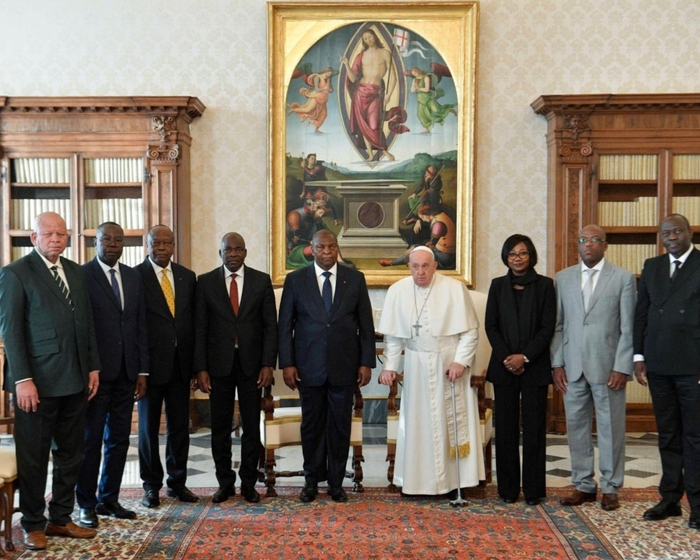
Pope Francis Meets With President of Central African Republic
Pope Francis grants an audience to the President of the Central African Republic, Mr Faustin Archange Touadéra.
Pope Francis received President Touadéra of the Central African Republic this morning for a meeting that lasted for around twenty minutes.
The President then held talks with Holy See Secretary of State Cardinal Parolin, and Archbishop Gallagher, Secretary for Relations with States.
During the talks, held at the Secretariat of State, discussion focused on the good relations between the Holy See and the Central African Republic, as well as the important role played by the Catholic Church in the country.
The Pope’s visit to the nation in 2015 was discussed, as were some aspects of the social, political and humanitarian situation in the region.
Both parties expressed hope that there might be an ever more effective cooperation at international level for the common good of the nation.
Pope Francis presented President Touadéra with a bronze sculpture entitled “Dialogue between Generations”, volumes of papal documents, and his Peace Message for 2024.
The Pope meets with members of an Italian non-profit that raises funds for an orphanage in Rwanda founded in the wake of the country's 1994 genocide. By Joseph Tulloch
"That genocide was terrible, it was terrible. Never forget it, so it can never happen again."
Those were Pope Francis' words on Saturday morning as he met with a group from the Italian non-profit Nolite Timere (‘Do not fear’).
The organisation raises funds for an orphanage in Mbare, Rwanda, founded to serve children orphaned by the 1994 Rwandan genocide.
25 years of solidarity
Nolite Timere's slogan, Pope Francis noted, is ‘Giving the hope to start again.’
“To start again”, the Pope repeated. “This is beautiful, and it is beautiful that you have lived it out in such a tangible way, welcoming hundreds of children to the Cité.”
The Cité of Nazareth, an orphanage just outside the Rwandan capital Kigali, was founded by Archbishop Salvatore Pennacchio, Papal nuncio in the country from 1998 to 2003. According to Nolite Timere’s website, the Cité currently hosts 429 orphans and poor children from across the country.
“For a quarter of a century,” Pope Francis said, “you have been working together for children, with an open spirit and unconditional love, united by a common desire to give them a smile and a hope for the future.”
Friendship, not walls
The Pope also reflected on the Cité's logo, which, he noted, “depicts a Rwandan basket, a symbol of solidarity and sharing.”
“This reminds us,” the Pope said, that “in a world where walls and divisions between people and between peoples are multiplying, charity has no barriers.”
IOM Director General: Pope Francis offers Eloquent Voice On Migration
Following an audience with Pope Francis, Amy Pope, the Director General of the UN International Organization for Migration, praises the Holy Father’s passionate advocacy regarding migration and laments how migrants are often vilified in election years. By Devin Watkins
Pope Francis met Friday with Amy Pope, Director General of the United Nations International Organization for Migration (IOM), during a private audience in the Apostolic Palace.
In their conversation, the Pope and Ms. Pope shared a joke about their meeting being “an opportunity for the two Popes to meet.”
“I have to admit it was a real pleasure for me to meet the Pope,” she said afterwards in an interview with Vatican News, adding that she thanked the Holy Father (another papal moniker which might cause less confusion) for his advocacy on behalf of migrants around the world.
“He’s an incredible voice, and at this moment in time when so much of the rhetoric around migration is so negative, having someone like the Holy Father speak out so passionately and eloquently on the subject is incredibly important, not just for our organization, but for millions of people around the world.”
Recasting the narrative
According to Ms. Pope, the Holy Father constantly seeks to remind people that migration has a human face and involves real human lives.
“We're both mindful of the fact that half of the world is voting this year,” she said. “Unfortunately, in many conversations around elections migrants are being vilified and blamed for issues and problems within societies.”
However, she added, migration has many positive effects on host countries, fostering innovation and driving development.
UN Human Rights Commissioner: From Tech To Ceasefires, A Call For Dignity And Peace
Following an audience with Pope Francis, the United Nations' High Commissioner for Human Rights, Volker Türk, stresses the importance of respecting international law and human rights, expressing concerns about the impact of technology on conflicts, calling for a ceasefire in the Middle East, and condemning the death penalty while advocating for a world based on human rights and dignity. By Francesca Merlo
There are rules that apply in war, an international law that should be respected, even as violence is perpetrated. “Unfortunately, these rules are not respected.”
A "champion" of the cause
Volker Türk, the United Nations’ High Commissioner for Human Rights, talks about the importance of respecting International Law but also International Human Rights Law. But for this, the world needs to realise the right to peace.
This formed a topic of conversation between the High Commissioner and the Holy Father during their meeting on Friday, 26 January.
“The Holy Father is a champion of the Human Rights cause in the world,” Mr. Türk told Vatican News. “We discussed the conflicts ravaging our world, and we discussed the dangers of artificial intelligence," he says. “We know that when you have social media platforms and generative artificial intelligence combined, this could actually have a negative impact on the democratic space because you will have the spreading of false news, fake news, of disinformation, of hate speech, and it's really important to counter that.”
History vs AI
But this technology goes further than affecting speech and information. It makes age-old conflicts worse, creating paradoxical situations.
Today we kick off the 50th anniversary of National Catholic Schools Week? Our #ADWcommUNITY begins this special week in prayer by celebrating the heart of our community – our parishes.