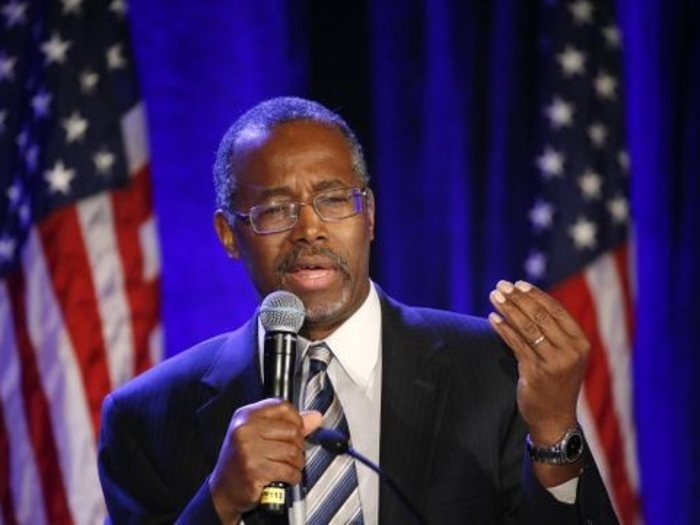
Prison proves that there are consequences for actions, evil is real, and according a 2016 presidential hopeful, homos*xuality is a choice. Earlier, brain surgeon and potential presidential candidate Ben Carson was interviewed by CNN's Chris Cuomo and asked whether he thought homos*xuality was a choice. Short and sweet, getting straight to the point, Carson answered "Absolutely."
"A lot of people who go into prison go into prison straight — and when they come out, they're gay. So, did something happen while they were in there? Ask yourself that question." Using a type of Socratic method in his answer, Carson turned the table on Cuomo and began asking him a series of questions, leaving him no choice but to listen.
"Why do gay people want to get married? Why do they say they want to get married? Because they want to have various rights — property rights, visitation rights…Why can't any two human beings, I don't care what their s*xual orientation is, why can't they have the legal right to do those things? That does not require changing the definition of marriage."
In the context of a conversation on the legality of gay marriage, Carson, the scientific surgeon, positioned himself against the overwhelming majority of scientific data. "I don't know of any research that substantiates the claim that men to go to prison and come out gay. There's no data to support that claim," said Helen Eigenberg, professor of criminal justice at the University of Tennessee. "In the 1950s or '60s there was a concept of situational homos*xuality that talked about men going to prison and 'became gay' because of the lack of women in prison...But that concept is not accepted among experts in the field any longer."
Not limited to the medical arena, Carson is differentiating himself from the other potential Republican candidates. It is important to note that while none of the potential candidates have come out in support of same-s*x unions, they have been relatively silent and expectedly vague. Jeb Bush said, "I hope that we can also show respect for the good people on all sides of the gay and lesbian marriage issue."
Scott Walker, when asked, said "To me, I'd rather be talking in the future now more about our jobs plan and our plan for the future of the state. I think that's what matters to the kids. It's not this issue." Rand Paul said, "I don't really think the government needs to be too involved with this, and I think the Republican Party can have people on both sides of the issue." Which it has, as evidenced earlier this week when the California GOP officially recognized the Log Cabin Republicans, a gay conservative group.
Creating a type of niche for himself, Ben Carson appears to be appealing to a populist evangelical voting bloc on this particular issue. With this controversial position, he is extending an invitation to that voter, asking them to join him in the story he is telling. Not simply to join him at this point, but to be an active agent in making all of his points in the campaign story a governing reality. Ben Carson, the leader and chief storyteller, is embodying what Howard Gardner said in his book Leading Minds. Gardner asserts that the leader with an emotional appeal invites the followers into a story "that unfolds over time, in which they are the principal characters or heroes."
Ben Carson is telling a story, people are obviously listening, and the voter will have a choice as to whether to be a part of it. His reference to the big house might determine whether this campaign story ends in the White House or back at his own house.