BIRACIAL TEEN CHANGES HER NAME FROM "KEISHA" TO AVOID STEROTYPES (2460 hits)
Teen changes her name from Keisha because she encountered so much prejudice By JAMES NYE
PUBLISHED: 00:48 EST, 5 November 2013 | UPDATED: 02:11 EST, 5 November 2013
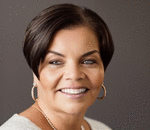
A mixed-race Kansas City teenager called Keisha has changed her name to avoid what she believes are damaging racial stereotypes some people link with certain popular African-American names.
Gifted the name-change by her mother as an early Christmas present at the cost of $175, Keisha Austin, 19, hopes that by calling herself Kylie she will avoid being associated with the negative connotations she feels the name provokes.
Left conflicted and emotional by her decision to rename herself, the teen stood before a Johnson County Judge last week and made the change official - finally comfortable with her new identity.
'It’s not something I take lightly,' said the teen to the Kansas City Star.
'I put a lot of thought into it. I don’t believe you should just change your name or your face or anything like that on a whim.
'I didn’t want to change my name because I didn’t like it. I wanted to change my name because it didn’t feel comfortable.
'I don’t connect to it. I didn’t feel like myself, but I never want any girls named Keisha, or any name like that, to feel hurt or sad by it.'
Uncomfortable since an early age with her name, Keisha said that because she did not grow up in a diverse community and has never known a lot of African-Americans, as she aged her name became a source of jokes.
Children at school would ask her is there was a 'La' or 'Sha' in front of her name, in comments that can only be taken as based at best in ignorance and at worst in racism.
'It’s like they assumed that I must be a certain kind of girl,' she said. 'Like, my name is Keisha so they think they know something about me, and it always felt negative.'
One teacher even asked her if there was a dollar sign in her name like the pop singer Ke$ha.
Songs such as 'Keisha'a Pain' about a poor young girl who sells her body to get by in life added to her discomfort.
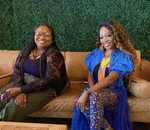
Going to her mother, Cristy, who is white, Keisha explained how much she wanted to change her name.
In turn, her mother told her why she had christened her that in the first place.
As a single mother, Cristy chose it because she wanted a name that represented a strong African American identity.
'I saw it as a source of pride,' Cristy says. 'I wanted her to have that.'
However, her daughter was adamant over the name-change and Cristy decided that it would be a Christmas present, despite believing her daughter had a perfectly fine name in the first place.
'It felt like a gift I gave to her, and she was returning it,' Cristy says.
'But she’s still the same person, regardless of her name. But her happiness is what is most important to me.
'I love and support her, and whatever she has to do to feel good on the inside, I have to be OK with that.'
Indeed, two papers dated from 2011 from the Cambridge-based National Bureau of Economic Research draw somewhat different conclusions about whether a black name is a burden.
One, an analysis of the 16 million births in California between 1960 and 2000, claims it has no significant effect on how someone's life turns out.
The other, however, suggests a black-sounding name remains an impediment to getting a job.
After responding to 1,300 classified ads with dummy resumes, the authors found black-sounding names were 50 percent less likely to get a callback than white-sounding names with comparable resumes.
If nothing else, the first paper, by the NBER's Roland Fryer and the University of Chicago's Steven Levitt, based on California birth data, provides probably the most detailed snapshot yet of distinctive naming practices.
It shows, for instance, that in recent years, more than 40 percent of black girls were given names that weren't given to even one of the more than 100,000 white girls born in the state the same year.
The paper says black names are associated with lower socioeconomic status, but the authors don't believe it's the names that create an economic burden.
The University of Chicago's Marianne Bertrand and MIT's Sendhil Mullainathan, however, appeared to find that a black-sounding name can be an impediment, in another recent NBER paper entitled 'Are Emily and Greg More Employable Than Lakisha and Jamal?'
The authors took the content of 500 real resumes off online job boards and then evaluated them, as objectively as possible, for quality, using such factors as education and experience.
Then they replaced the names with made-up names picked to 'sound white' or 'sound black' and responded to 1,300 job ads in The Boston Globe and Chicago Tribune last year.
Previous studies have examined how employers responded to similarly qualified applicants they meet in person, but this experiment attempted to isolate the response to the name itself.
White names got about one callback per 10 resumes; black names got one per 15. Carries and Kristens had call-back rates of more than 13 percent, but Aisha, Keisha and Tamika got 2.2 percent, 3.8 percent and 5.4 percent, respectively.
And having a higher quality resume, featuring more skills and experience, made a white-sounding name 30 percent more likely to elicit a callback, but only 9 percent more likely for black-sounding names.
Even employers who specified 'equal opportunity employer' showed bias, leading Mullainathan to suggest companies serious about diversity must take steps to confront even unconscious biases - for instance, by not looking at names when first evaluating a resume.
We all know names that carry a black connotation are viewed negatively and may hinder your chance of employment. That's been proven over and over again. I understand why she did it, but I think it's sad she did it. What she could have instead done was to contribute to being one of the many successful Keisha's (like Keisha Knight Pulliam) and break the stereotype down with success.
Wednesday, November 6th 2013 at 12:04PM
Siebra Muhammad
my mother named me kemetria marie, my children all have names beginning with the letter k, i tell them 'k' stands for 'kool' lol, and i have to say as a kid I used to be embarrassed of my name and dreaded the first day of school when we had to introduce ourselves, these days I love the name, especially the way it looks on my business card
Monday, November 11th 2013 at 1:50PM
Kemetria 'Kim' Smith
i think the name siebra is unique, and i've always liked unis*x names like lee too, because no one would know if you were male or female or black or white until they saw you lol
Monday, November 11th 2013 at 1:53PM
Kemetria 'Kim' Smith
My middle name is Aisha, which I never had no problems with. But I felt that way about my first name for the longest time and my name is not a very popular name. Not to the point of changing my name, but because my teachers and close friends were either pronouncing it "Sabrina" or "Sierra" or kept spelling it wrong.
I just happen to ask my parents one day "Why they gave me my name?" and they said something to the point of they wanted something that sounded happy no matter how you say it. Now I'm comfortable with my name, great conversation starter, people who meet me especially seem to be fond of it. And I don't have to worry about other people having my name (smile)
Monday, November 11th 2013 at 2:08PM
Siebra Muhammad
HOPEFULLY AS SHE CONTINUES TO LEARN ABOUT THE UPS AND DOWNS IN LIFE ARE ON GOING...SHE WILL LEARN WHO SHE IS AND IT IS HER AND ONLY HER THAT CAN' DETERMINE HER OWN SELF WORTH TO HER SELF. (SMILE)...
I HATE MY MIDDLE NAME OF LEE...BECAUSE IT 'PROFILES A SOUGHTRN FEMALE AS ONLY LIMITED TO NAMES LIKE: SUE, MAY AND LEE.LOL!!!(SMILE)
Thursday, April 10th 2014 at 6:47PM
ROBINSON IRMA