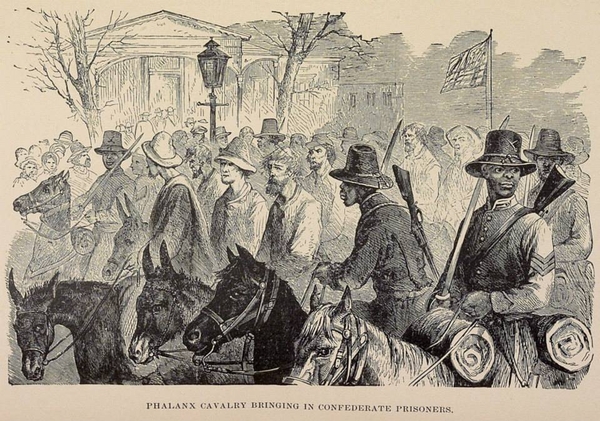
Black history note BLACK PHALANX CALVARY BRINGING IN WHITE CONFEDERATE PRISONERS! (630 hits)
SEE PIC
Shortly after this Colonel Williams received information that one of the prisoners held by Livingstone had been murdered by the enemy.
He immediately sent a flag of truce to Livingstone demanded the body of the person who committed the barbarous act.
Receiving an envious and unsatisfactory reply, Colonel Williams determined to convince the rebel commander that that was a game at which two could play and directed that one of the prisoners in his possession be shot, and within 30 minutes the order was executed."
He immediately informed Major Livingstone of his action, sending the information by the same party that brought the dispatch to him.
Suffice it to say that this ended the barbarous practice of murdering prisoners of war, so far as Livingstone's command was concerned.
------------------- Click to listen to Black History weekly on The Gist of Freedom www.blackhistoryUniversity.com Join us as John Franklin, the Smithsonian's National Museum of African American History and Culture (NMAAHC) specialist talks about the origins of African American Holidays, Black Holidays!
Author & Abolitionist JOSEPH T. WILSON we beg to say, is not altogether unknown to the literary world, having already published several works relative to the Negro race.
His services during the war of the Rebellion secured for him a flattering recognition. He served in the 2nd Regiment Louisiana Native Guard Volunteers, also the 54th Massachusetts Volunteers,—the most famous of the Union negro regiments that engaged in the struggle, receiving several wounds. He was the first negro member of the National Council of Administration of the Grand Army of the Republic, and a delegate to the National Encampment, and was appointed Colonel—A. D. C. to the Commander-in-Chief G. A. R. He was chosen by his comrades to be the historian of the negro soldiers, and has overcome many almost insurmountable difficulties in gathering the scattered facts, particularly those of the early wars of the United States, that were necessary to complete this work.