Pakistan's Buddhist Roots on Show (Photos) (1001 hits)
Museum exhibit highlights Pakistan's Buddhist roots
(CNN) -- A statue resembling the goddess Athena and jewelry bearing images from Greco-Roman mythology may not be objects you'd expect to see in a museum exhibit of Buddhist art from Pakistan.
Their presence among carvings of Buddha and Indian deities is meant to serve as a reminder of Pakistan's oft-forgotten multicultural roots, which form the basis of a new exhibit, "The Buddhist Heritage of Pakistan: Art of Gandhara."
The show, which runs until October 30 at New York's Asia Society, is the first to bring works of Gandharan art to the United States since 1960. The pieces, on loan from museums in Karachi and Lahore, highlight Pakistan's history as a crossroads of cultural influences, despite present-day associations of the country as an incubator of religious extremism, museum director Melissa Chiu said.
"When we think of Pakistan, Americans might associate it with the place where Osama bin Laden was captured, with terrorism and natural disasters," she said. "But actually, it has a much longer history that dates back to an ancient culture that gives us a sense of a pluralistic tradition that was all about tolerance."
At its height, Gandhara encompassed present-day Peshawar in northwest Pakistan and parts of eastern Afghanistan, the Hindu Kush, and northwest India, making it a major center of trade, commerce and the development of arts and education. Pakistan may be 95% Muslim today, but Buddhism flourished in Gandhara between the 2nd century B.C. and 10th century A.D., giving rise to a distinct style of Buddhist visual art.
The statue of Athena and a gold carving of Aphrodite in the exhibit demonstrate the early influence of Greco-Roman culture in the region, which began with its conquest by Alexander the Great. Themes from classical Roman art persisted in Gandharan art even as Buddhism began to flourish in the first century A.D., fostered by Silk Road trade and cross-cultural connections from the Mediterranean to China.
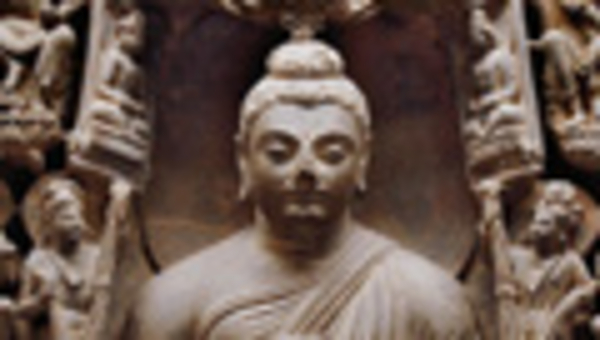
Depictions of the Buddha and the concept of bodhisattvas, or "enlightened beings," became the main icons of Gandharan art. A section of the exhibition, "Buddhas and Bodhisattvas," explores the diverse visual imagery of Buddha and bodhisattvas in Gandhara and how it relates to the multifaceted nature of Buddhism in the region. ...