Mixed-Race Growth in Mississippi Signals a Shift in Attitudes (2641 hits)
Well, actually the statistically surprising uptick in mixed race identification below the Mason-Dixon line is only partly due to births in the last 10 years, demographers say. The only way to explain a 70 percent increase in mixed race identity in Mississippi over the past decade, 80 percent in Georgia and equally staggering numbers in other southern states, is that people who once checked only one box on the census, are now checking off two or three. There seems to have been a shift in racial identity.
Have you changed the way you fill out your census form now that you can check off multiple boxes?
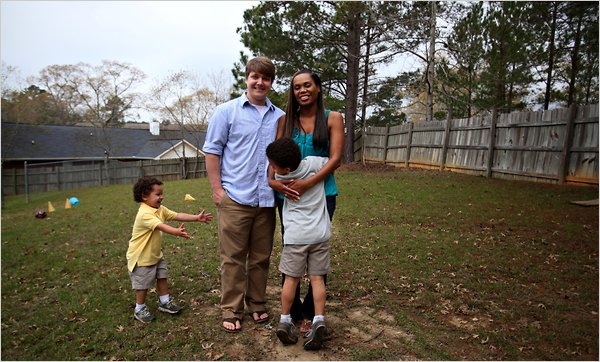
HATTIESBURG, Miss. — For generations here in the deepest South, there had been a great taboo: publicly crossing the color line for love. Less than 45 years ago, marriage between blacks and whites was illegal, and it has been frowned upon for much of the time since. So when a great job beckoned about an hour’s drive north of the Gulf Coast, Jeffrey Norwood, a black college basketball coach, had reservations. He was in a serious relationship with a woman who was white and Asian.
“You’re thinking about a life in South Mississippi?” his father said in a skeptical voice, recalling days when a black man could face mortal danger just being seen with a woman of another race, regardless of intentions. “Are you sure?” But on visits to Hattiesburg, the younger Mr. Norwood said he liked what he saw: growing diversity. So he moved, married, and, with his wife, had a baby girl who was counted on the last census as black, white and Asian. Taylor Rae Norwood, 3, is one of thousands of mixed-race children who have made this state home to one of the country’s most rapidly expanding multiracial populations, up 70 percent between 2000 and 2010, according to new data from the Census Bureau.
“Anything over 50 percent is impressive,” said William H. Frey, a sociologist and demographer at the Brookings Institution. “The fact that even states like Mississippi were able to see a large explosion of residents identifying as both black and white tells us something that people would not have predicted 10 or 20 years ago.” Census officials were expecting a national multiracial growth rate of about 35 percent since 2000, when seven million people — 2.4 percent of the population — chose more than one race. Officials have not yet announced a national growth rate, but it seems sure to be closer to 50 percent. ...
Once again, I will stick with modern science. The very concept of race is obsolete, and that our leaders (the Census Bureau no less!) even use the word is ridiculous. Here, from the Smithsonian Institute. SCIENCE PLEASE!
Modern Human Diversity - Genetics
People today look remarkably diverse on the outside. But how much of this diversity is genetically encoded? How deep are these differences between human groups? First, compared with many other mammalian species, humans are genetically far less diverse – a counterintuitive finding, given our large population and worldwide distribution. For example, the subspecies of the chimpanzee that lives just in central Africa, Pan troglodytes troglodytes, has higher levels of diversity than do humans globally, and the genetic differentiation between the western (P. t. verus) and central (P. t. troglodytes) subspecies of chimpanzees is much greater than that between human populations.
Early studies of human diversity showed that most genetic diversity was found between individuals rather than between populations or continents and that variation in human diversity is best described by geographic gradients, or clines. A wide-ranging study published in 2004 found that 87.6% percent of the total modern human genetic diversity is accounted for by the differences between individuals, and only 9.2% between continents. In general, 5%–15% of genetic variation occurs between large groups living on different continents, with the remaining majority of the variation occurring within such groups (Lewontin 1972; Jorde et al. 2000a; Hinds et al. 2005). These results show that when individuals are sampled from around the globe, the pattern seen is not a matter of discrete clusters – but rather gradients in genetic variation (gradual geographic variations in allele frequencies) that extend over the entire world. Therefore, there is no reason to assume that major genetic discontinuities exist between peoples on different continents or "races." The authors of the 2004 study say that they ‘see no reason to assume that "races" represent any units of relevance for understanding human genetic history. An exception may be genes where different selection regimes have acted in different geographical regions. However, even in those cases, the genetic discontinuities seen are generally not "racial" or continental in nature but depend on historical and cultural factors that are more local in nature’ (Serre and Pääbo 2004: 1683-1684).
@ Brother Rich, Here we go again... proving once more that great minds do really think alike!
@ Brother Steve, I believe you and I think the whole notion of race is obsolete when we try to distinguish or make differences between us. For me that is only one Race and that being the Human Race.
Its not the place any longer, it's all about the people.Yes not so long ago was an ugly time for America, but we can all see the differences, changes and cultrural shifts. Some places are still non acceptant of man let alone a man of a different race. At least Mr. Norwood(the younger) married her and is the provider for his family. Times have changed for the better. Love the one your with. Cool story. @ Jen - you are absolutly right.
Tuesday, March 22nd 2011 at 10:02AM
Michael Daniel
@ Brother Micheal, Things have changed and are continuing to change one person at a time. We can't continue to hold on to Jim Crow philosophies in a Global World where people of various backgrounds have and are proving to be major players in moving the market.
Tuesday, March 22nd 2011 at 2:41PM
Jen Fad