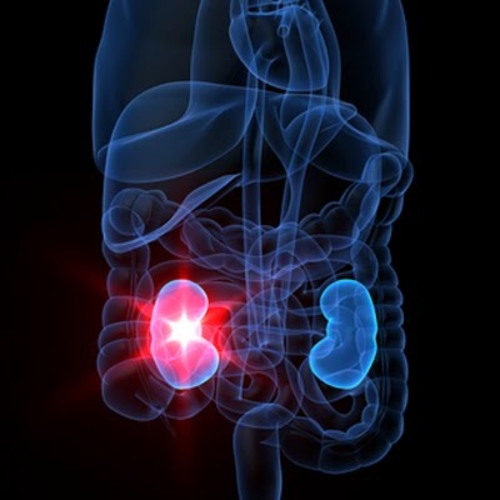
When your health care provider makes the diagnosis of end-stage renal disease, he or she will discuss your treatment options. Whether kidney transplantation is an option for you depends on your specific situation. If your health care provider thinks you may be eligible for a transplant, you will learn about the pros and cons of this treatment. If you are a potential candidate, you will undergo a thorough medical evaluation. In the meantime, you will be treated with dialysis. Kidney transplantation is replacement of nonworking kidneys with a healthy kidney from another person (the donor). The healthy kidney (the "graft") takes over the functions of your nonworking kidneys. You can live normally with only one kidney as long as it functions properly.
The transplantation itself is a surgical operation. The surgeon places the new kidney in your abdomen and attaches it to the artery that supplied blood to one of your kidneys and to the vein that carries blood away from the kidney. The kidney is also attached to the ureter, which carries urine from the kidney to the bladder. Your own kidneys are usually left in place unless they are causing you problems, such as infection. Every operation has risks, but kidney transplantation is not a particularly difficult or complicated operation. It is the period after the surgery that is most critical. Your medical team will watch very carefully to make sure that your new kidney is functioning properly and that your body is not rejecting the kidney. Are you eligible for a transplant? Before you can receive a kidney transplant, you must undergo a very detailed medical evaluation.
~This evaluation may take weeks or months and require several visits to the transplant center for tests and examinations. ~The purpose of this thorough evaluation is to test whether you would benefit from a transplant and can withstand the rigors of the surgery and antirejection medications and the adjustment to a new organ. ~Your medical team, which includes a nephrologist, a transplant surgeon, a transplant coordinator, a social worker, and others, will conduct a series of interviews with you and your family members. ~You will be asked many questions about your medical and surgical history, the medications you take and have taken in the past, and your habits and lifestyle. ~It will seem like they ask every imaginable question at least twice! It is important that they know every detail about you that could bear on a future transplant.
~They also want to make sure you are mentally prepared for following the necessary medication regimen. ~You will also have a complete physical examination. Lab tests and imaging studies complete the evaluation. ~Your blood and tissue will be typed so that you can be matched to a donor kidney. This significantly lessens the chance of rejection. ~You will have blood and urine tests to monitor your creatinine level, other organ functions, and electrolyte levels. ~You will have x-rays, ultrasounds, CT/MRI scans, and other imaging tests as needed to make sure your other organs are healthy and functioning.
Any of the following conditions significantly increase your chance of rejecting the new kidney and may make you ineligible for transplant: ~Active cancer ~HIV infection ~Serious heart or lung disease ~Positive results for hepatitis C ~Severe infection
Potential kidney donors also must be in good health and undergo a thorough medical evaluation. If you are considered eligible for a transplant, every effort will be made to find a donor among your family members (who are most likely to match) and friends. If no suitable donor can be found, your name will be added to the waiting list for a donor kidney. ~This list is administered by the Organ Procurement and Transplantation Network, which maintains a centralized database of everyone waiting for a transplant and of living donors. ~OPTC is run by the United Network for Organ Sharing, a private nonprofit organization. ~Every new kidney that becomes available is tested and checked against this list to find the most perfect match. ...