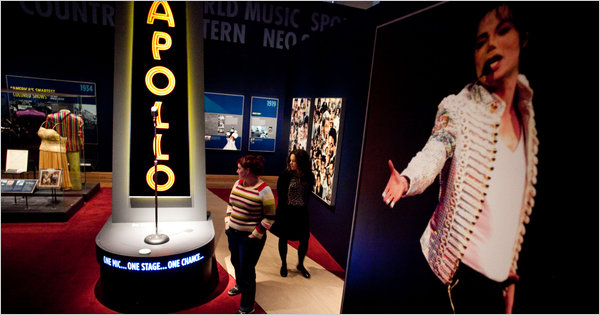
The exhibition “Ain’t Nothing Like the Real Thing,” which opens on Tuesday at the Museum of the City of New York, really ain’t anything like the real thing, but that is not really its fault. The “real thing” being the actual 1,500-seat theater on 125th Street in Harlem in this case is almost beyond the reach of a museum show.
Having said that, the 1,500-seat theater on 125th Street in Harlem really did transform American popular-music culture in the 20th century. A habitat and an incubator, the Apollo has also been one of the few institutions in which black American musical culture was consistently nurtured over the course of 75 years.
Carnegie Hall achieved its stature through architectural beauty; its warm, revealing acoustics; and a growing heritage of magnificent performances. The Apollo achieved its stature because of where it is — on the edge of one of America’s great black urban neighborhoods — and because of who appeared there during an era that went from vaudeville to hip-hop, from racial segregation to economic gentrification.
The Apollo heritage is evident even in simple lists, one of which appears at this exhibition: the stars who began their careers as winners of Amateur Night, Louis Armstrong’s, Miles Davis, James Brown, Ella Fitzgerald, The Jackson Five. ...