The Atlantis Code (part 1):: Pre-Sumeria { Just The Beginning Of A History Lesson } (446 hits)
Sumerian Influence and Empire Building
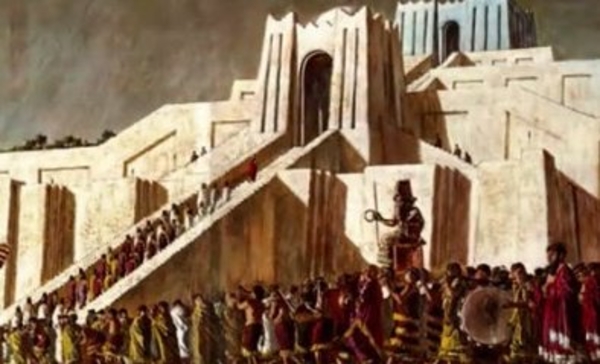
Proof exists that the Sumerians were the first of the “empire” builders that passed through the lineage of Shem and Abraham, and which Israel inherited and continued, right up to the present in which the United States and the British Commonwealth countries (Israelite Tribes grown into nations) continued. Whether Sumeria was an empire, or just an advanced “civilization,” its influence was worldwide. Jean Hunt makes some interesting comments: “Joseph Campbell wrote an exhaustive study of mythology in four volumes, under the umbrella-title, The Masks of G-d. In these volumes, he examined the oral and written literature, and history, art, archaeological data, and anthropological information on living primitive groups. The first volume was printed in 1959, the last in 1968; Campbell therefore did not have the benefit of the definitive dating which began appearing in the mid-1970s. He commented on an odd ‘truncation,’ not explainable by the data available at that time: the major reservoirs of information began in Sumer (Italics added), about 4000 BCE, and spread out swiftly into Africa, Europe, India, China, and North and South America within a 2000-year period. Campbell remarked on this sudden ‘mushrooming’ of literacy, astronomy, mathematics, formalized religion, and the invention of the wheel with no then-known ‘bed,’ other than the microlithic flints of the Capsian ‘Mesolithic’ culture. “The new dating information, which places a highly sophisticated, technologically advanced civilization in Western Europe, moving outward and spreading its culture, partly closes the gap; the continuity of their religion, in particular, is suggested by practices involving a priesthood, hero themes, puberty rites, names of gods, rites and rituals, and other elements, especially when exactly similar details are found in widely separated geographical areas and culture groups.”[14] Just how far did Shem’s empire extend, and how far did his influence spread? Claiming no absolute certainty, we see Sumerian examples of language, building structures, and other examples all around the world. Even religious and mythological similarities abound. Considering the similarities of language, culture, and religion, from the Indus Valley to the Middle East, Jean Hunt[15] says: “The Sumerians...in their ancient traditions remembered that the civilization of their country and the art of writing had come from the East. The Babylonian priest Berossus, while writing the history of Mesopotamia in the third century BCE, carefully collected all the ancient traditions of the land...he avers that in very early times there was no civilization in the land and that its people were like brutes...some people came from the east by sea and taught them civilization and the art of writing.” Note that “coming by sea” could mean coming across the Flood waters, probable indication being that Shem’s kingdom had risen before the Flood and continued after it. Remember that Shem was almost 100 years old at the time of the Deluge. “Shem” means “the Appointed One” his pre-eminence was divinely destined to him, of the three sons of Noah. Regarding skeletal findings and other evidence of relationship between (Minoan Crete) and the people in India, Sumer, and Egypt, Hunt (still quoting Heras) says, “...Skull measurements have shown that it would be difficult to choose between the primitive Indian or Egyptian series as the group to which the Sumerians are closer. It is acknowledged moreover that Egypt received the main elements of its civilization from the lands of Mesopotamia where an older civilization was already in existence (Italics added). The first Pre-dynastic Culture forms the foundation of the later Egyptian development and was no doubt due in the main to the native Hamitic population of North Africa carrying on the tradition of the higher type of culture that had been introduced into the Nile valley by the Badarian people (of Sumer). It underwent a still further development at a later period owing to the appearance in Egypt of the new type of civilization known as the second Pre-dynastic Culture (which is described as Semitic from Palestine). “Poisson acknowledges that the cult of Osiris (Nimrod and the pagan religion) owes its origin to the Asiatic current, just as the cult of Set (Seth, the son of Adam and representing the true ‘religion’) is due to another race; the fight between these two gods personifies the fight of the two races. There is evidence of specific contact between Egypt and Sumerian culture during the period of the rise and establishment of the Egyptian kingdom.”[16] If not a world empire by military conquest, the Sumerian civilization was, at the very least, a worldwide “empire” with its cultural and scientific influences.
Reference 16: Ibid., pp. 164 Reference 14: 14] Hunt, Jean, Tracking the Flood Survivors, p. 259. Reference 15: [15] Hunt is quoting H. Heras’, Studies in Proto-Indo-Mediterranean Culture, Bombay Indian Historical Research Institute, Bombay, India, 1953.