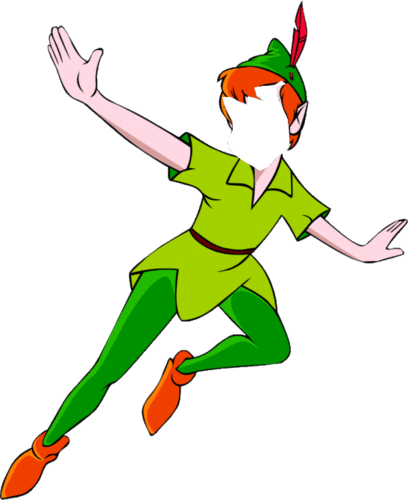
The sempiternal Peter Pan /a reaction to prolonged abuse and trauma in early childhood (1419 hits)
the eternal adolescent, the sempiternal Peter Pan – is a phenomenon often associated with pathological narcissism. People who refuse to grow up strike others as self-centred and aloof, petulant and brattish, haughty and demanding – in short: as childish or infantile.
Pathological narcissism is a reaction to prolonged abuse and trauma in early childhood or early adolescence. The source of the abuse or trauma is immaterial - the perpetrators could be parents, teachers, other adults, or peers. Pampering, smothering, spoiling, and "engulfing" the child are also forms of abuse.
In an abusive environment, the child finds it difficult to assert his personal boundaries, to separate from his parents, and to individuate. Consequently, it chooses either of two solutions: to internalize and introject the abuser (to become a monster), thereby siding with the strong and winning party – or to remain a child forever, thus securing empathy, compassion, and pity in a heartless, hostile universe. The typical narcissist is unusual in that it chooses to adopt both solutions at once and is, therefore, simultaneously a monster and a child.
The narcissist is a partial adult. He seeks to avoid adulthood. Infantilisation – the discrepancy between one's advanced chronological age and one's retarded behaviour, cognition, and emotional development – is the narcissist's preferred art form. Some narcissists even use a childish tone of voice occasionally and adopt a toddler's body language.
But most narcissist resort to more subtle means.
They reject or avoid adult chores and functions. They refrain from acquiring adult skills (such as driving) or an adult's formal education. They evade adult responsibilities towards others, including and especially towards their nearest and dearest. They hold no steady jobs, never get married, raise no family, cultivate no roots, maintain no real friendships or meaningful relationships.
Many a narcissist remain attached to their families of origin. By clinging to his parents, the narcissist continues to act in the role of a child. He thus avoids the need to make adult decisions and (potentially painful) choices. He transfers all adult chores and responsibilities – from laundry to baby-sitting – to his parents, siblings, spouse, or other relatives. He feels unshackled, a free spirit, ready to take on the world (in other words omnipotent and omnipresent).
This curious abdication may have to do with what I termed the “Inversion-Null Dynamic.” Briefly: the narcissist always seeks to fulfil the role of a child. His parents, his spouse, even his own kids usually compliantly respond to this hidden signal. This is the “inversion” part.
Then, when another child enters the scene (the narcissist’s siblings, or his own newborn offspring), everyone react awkwardly, dismissively, or abusively towards the addition to the family because it is perceived as threatening to usurp the narcissist’s role and to upset the delicate dynamics and equilibrium that rule the narcissist’s intimate relationships. We live in a culture that celebrates youth and beauty and independence—even at the expense of growing up. Many young men today immerse themselves in a world of media entertainment and diversions that tell them it’s okay to live a self-centered lifestyle, free of commitments to anything beyond endless and mindless pleasure.
In a world like this, where can men—young and old—learn how to become real men? The simple answer is: From other men. Whether we are young or old, we need other men in our lives who will teach us, model for us, and encourage us to make the right choices.
Husbands and fathers need to step up and take responsibility for raising the next generation.
Boys growing up without fathers need men who will step into their lives and mentor them.
And young men who refuse to grow up need peers and mentors who will exhort them to act like men.
As Dennis Rainey, president of FamilyLife, writes, “While none of us ever outgrow the need for having other men to mentor us, it is an absolute essential for those who would admit that their teenage tendencies are still pretty strong inside. If you find yourself grown but still exhibiting immature, adolescent behavior on a fairly regular basis, you need people around you who can call you up and out.”