Understanding the Bible from a Hebrew Prospective Breakdown (1014 hits)
A language is closely tied to the culture or nationality of those who speak the language. In the case of the Hebrews who were a nomadic people of the Near East, their language is closely connected to their nomadic culture. Each Hebrew word describes an action that can been seen in the nomadic journeys of the Hebrews through the wilderness.
All modern day translations of the Bible are written from a very westernized perspective and have erased the original Hebraic, Eastern, perspective of the original words in the text.
It is simply assumed by most people that everyone everywhere thinks in pretty much the same manner. This could not be farther from the truth. In fact, the thinking processes of different cultures are as different as day is from night. Understanding how the Ancient Hebrew thought is crucial in proper Biblical understanding. If we are to interpret the Biblical text according to Hebrew way of thinking then the interpretation will be contaminated with modern Greco-Roman thinking.
Hebrew thought is more concerned with function whereas we, and our Greco-Roman thought, are more concerned with appearance. When we read the Biblical text we are constantly creating a mental image of what the text is describing but the original author is not describing an image of appearance but an image of function.
Description of Noah's Ark Verse as an Example:
{and this is how you are to make it, the length of the vessel is three hundred cubits long, fifty cubits wide and thirty cubits high.}
Is this description telling us what the ark looked like??? Not at all, it is describing its function by telling us that this ark is very large and capable of transporting a very large load of animals.
When keeping these keys in mind while reading the scriptural text you will begin to approach the Bible from a Hebrew perspective rather from the Greek perspective we have all been taught since birth.
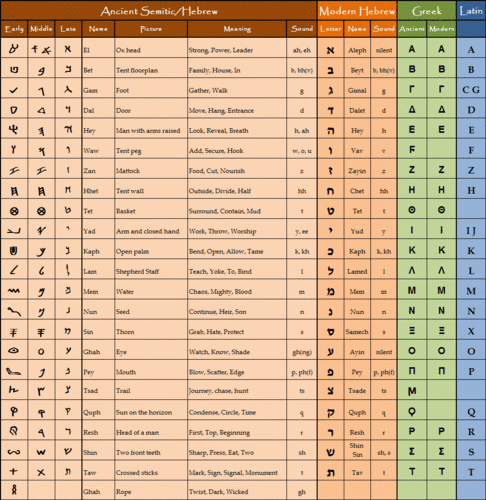
Now let's venture to the Hebrew Alphabet Chart with the 22 vowel letter consonants components that is read from right to left rather than English left to right. In this chart you will see the Modern (Aramaic Square Script), Middle Text (Paleo-Hebrew text which Saint uses frequently), Ancient Hebrew text (Pictorial).
Note in the Greek text the letters Y, M, Q was not carried over to modern Greek.
The letter J is non-existent in Hebrew and the letter P is additive however pronounced as "ph" which ancient meaning is: blow, scatter, edge.
Now in the Aramaic text the aleph or A in English text is silent in sound whereby in Ancient Hebrew it is pronounced "a". Also note that Aramaic 'ayin' is silent versus ancient Hebrew "ghan" is pronounced "gh" for the same ancient meaning of watch, know, shade.
Additional notes: The English verb "to be" and its various tenses such as "am", "is", and "are" do not exist in Hebrew and need to be added in the translation or transliteration.
English also has two indefinite articles, "a" and "an" which also do not exist in Hebrew and must be added in the translation.
I have attached the Hebrew Alphabet Chart in the attached Photo.
Saint wants to add some edifying "FACTS" about some of the biblical discussions on this forum.
I want to give another example of the word "Elohiym" or English words of 'God' or 'Most High". I would type the word in "Aramaic Square Text or Modern Hebrew" backward from right to left as follows:
you would need to type the final mem, the yud, the hey, the lamed and then the aleph.
Monday, September 2nd 2013 at 2:33PM
Yaiqab Saint